Unlock Elite Perks Faster with These Major Airline Credit Cards
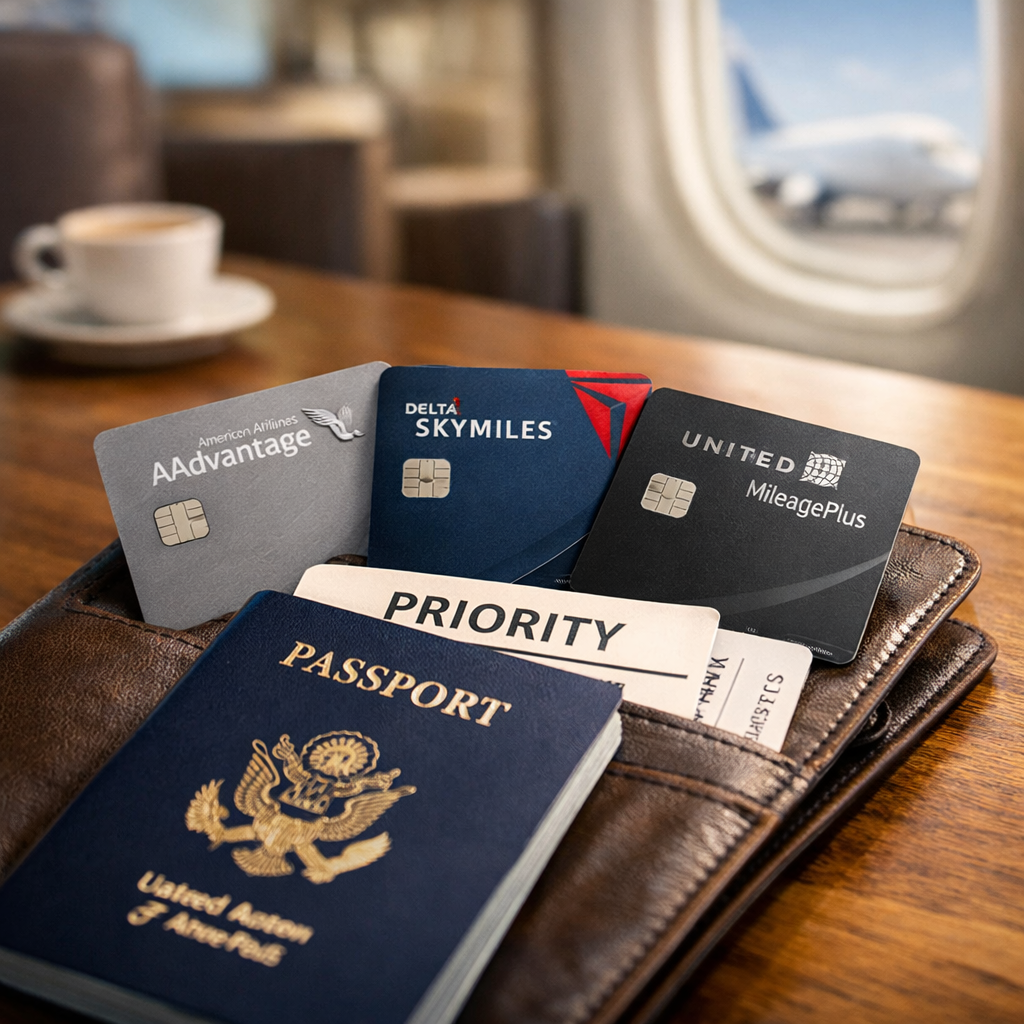
Unlock Elite Perks Faster with These Major Airline Credit Cards
Want the fastest path to priority boarding, free checked bags, and lounge time—without waiting years for status? The right co-branded airline card can deliver elite-like perks on your very next trip, and in some programs, your everyday spending can even accelerate status credits. At Points and Perks Guide, we cut through the noise with quick rules, clean tables, and a five-minute decision flow to match you to the best frequent flyer credit cards with elite-like perks. We also show when a general travel card is the smarter pick. Rule of thumb: if you fly one airline at least a few times a year and check bags or value lounges, an airline card can pay for itself quickly.
Points and Perks Guide five-minute decision flow
Use this rapid framework to pick confidently—then get moving.
- Identify your primary airline and alliance routes you actually fly
- Quick rule: Lock in the airline that dominates your home airport and the partners you book most often. If your flights are split across carriers, skip ahead to the general-travel section.
- Tally the annual value of perks you’ll use (bags, lounge, companion)
- Quick rule: If you check 4+ roundtrip bags on the same airline, a mid-tier co-branded card likely pays for itself via bag waivers alone, per typical perk structures summarized in NerdWallet’s best airline cards roundup.
- Check if spend accelerates status (Loyalty Points/PQP/TQPs)
- Quick rule: American’s select cards earn Loyalty Points from everyday spend; United and Southwest offer threshold-based credits—verify your card’s terms in TPG’s best airline cards guide.
- Compare value minus annual fee and required spend
- Quick rule: If your expected lounge visits + bag savings + any companion ticket value exceed the annual fee by 25% or more, you’ve found a keeper.
- Choose your primary card + a backstop general card
- Quick rule: Pair a co-branded airline card for fixed perks with a flexible-points card to protect against weak award space or dynamic price spikes.
Decision checkpoint: If you fly mixed carriers or take fewer than two roundtrips per year on one airline, pivot to the general travel card section below.
Quick rules for choosing an airline credit card
- Prioritize cards that cover free checked bags and priority boarding for companions on the same reservation—common on co-branded cards and central to their value.
- If you value lounges, know that ultra-premium airline cards often cost $500–$700 per year, per Simple Flying’s look at ultra-premium card trade-offs.
- Confirm activation: many benefits (PreCheck credits, companion tickets, hotel/luggage protections) require enrollment in issuer or airline portals, as CardRatings’ guide to travel card perks explains.
- Stat to know: 63% of frequent-flyer miles earned in 2022 came via airline credit cards, highlighting how critical cards are to travel value, per an Airlines for America report.
- Don’t chase upgrades alone: consider reliable, elite-like perks (bags, boarding, lounge entries) you’ll actually use.
- Keep a downgrade path in mind before you apply—so you can step down the fee later without losing the account age.
How airline cards unlock elite-like perks
“Elite-like perks are benefits that mirror formal elite status—priority boarding, free checked bags, preferred seats, lounge entry, and fee waivers—without actually holding status. These privileges often ride on mid-to-premium co‑branded cards, unlocking practical savings and smoother trips simply by carrying and using the right card.” Points and Perks Guide emphasizes predictable, bookable value—perks you can count on each trip over speculative upgrades.
What this looks like in practice:
- Priority services: Group/zone boarding, dedicated check-in, and sometimes preferred seating.
- Free checked bags: Often for you and companions on the same reservation.
- Lounge time: Club access or visit allowances on premium tiers.
- Statement credits: Trusted offsets like inflight purchases or Wi‑Fi.
- Companion tickets: Annual second-ticket offers that can subsidize a family trip.
- Program-specific boosts: On some American Airlines cards, purchases earn Loyalty Points toward status; Delta Reserve includes 15 Sky Club visits, and heavy spenders can unlock unlimited access with $75,000 in annual spend under current issuer terms, per TPG’s best airline cards guide.
Perk-to-Fee Calculator (quick math)
- Add: (annual lounge visits × your realistic per-visit value) + (bags saved × $30–$40 each) + (companion ticket net value after taxes/fees) + (credits you actually use).
- Subtract: annual fee.
- If your net is positive by a comfortable margin, keep. If not, consider a mid-tier or a general travel card.
American Airlines credit cards
American AAdvantage loyalists can parlay card spend into Loyalty Points, accelerating progress to elite tiers while unlocking checked bags, priority boarding, and—in premium tiers—Admirals Club access. Companion certificates on select cards can save families hundreds per year and may be eligible for complimentary elite upgrades on qualifying fares, per TPG’s best airline cards guide. For a lower-fee pick, the Citi AAdvantage Platinum Select often features 2x on AA purchases, restaurants, and gas plus a free checked bag on domestic itineraries for the cardholder, per CNBC Select’s airline card picks. For American flyers chasing status, Points and Perks Guide generally prioritizes cards that earn Loyalty Points; otherwise, the mid-tier pick covers core perks for less.
AA card lineup snapshot
| Fee tier | Key perks (bags/boarding/club) | Status from spend (Loyalty Points) | Authorized user notes |
|---|---|---|---|
| Premium (e.g., Admirals Club–tier) | Admirals Club access, priority boarding, first checked bag for eligible itineraries | Eligible purchases can earn Loyalty Points toward status (see issuer terms) | Some perks may extend to AUs for an added fee; verify access rules |
| Mid-tier (e.g., Platinum Select) | First checked bag, preferred boarding, accelerated earnings on common categories | Select earning may contribute to Loyalty Points depending on product | AUs may not receive lounge access; confirm benefit sharing |
Delta Air Lines credit cards
Delta flyers choosing between lounge time and lower fees should weigh Reserve vs Gold carefully. Delta SkyMiles Reserve American Express includes 15 Delta Sky Club visits annually; after $75,000 in calendar-year spend, cardholders can unlock unlimited access per issuer terms cited by TPG. The Reserve also typically carries a domestic companion certificate. For casual travelers, the SkyMiles Gold American Express delivers elite-like staples—first checked bag and priority boarding—at a lower annual fee.
Who it’s for
- Delta Reserve: Frequent ATL/DTW/MSP travelers who value Sky Club time and may spend enough to unlock broader lounge access.
- Delta Gold: Occasional Delta flyers who check bags and want priority boarding without a premium price tag.
United Airlines credit cards
United cards bundle priority services, bag waivers, and—on premium tiers—United Club access. Miles from spend generally don’t count toward status; however, select United products may earn Premier Qualifying Points (PQP) via spending thresholds. Terms vary; check your card before counting on PQP.
United highlights
- Entry-level: The United Gateway Card has no annual fee and a 0% intro APR on purchases for 12 months—handy for starting with MileagePlus but it offers minimal elite-like perks, per CNBC Select’s airline card coverage.
Mini table: United options
| Card | Annual fee | Lounge access | Free bags | PQP mechanics | Partner lounge notes |
|---|---|---|---|---|---|
| Gateway | $0 | None | None | None | N/A |
| Explorer (mid-tier) | ~$95 | 2 United Club passes/yr | 1st bag free (itinerary rules apply) | May offer limited PQP via thresholds (verify terms) | Some partner access when flying United on eligible tickets |
| Club Infinite (premium) | ~$525 | United Club membership | 1st & 2nd bags free (cardholder itinerary) | PQP earning varies by product; confirm eligibility | Star Alliance lounges when rules permit |
Southwest Airlines credit cards
If you live on Southwest, the cards can accelerate both tier-qualifying points and the Companion Pass. Some Southwest cards award 2,500 tier qualifying points (TQPs) for every $5,000 spent with no cap, and the Southwest Priority card provides a 10,000-point Companion Pass boost—powerful for domestic travelers optimizing two-for-one flying, per CNBC Select’s airline card picks.
Priority vs mid-tier
- Priority: Annual 7,500-point bonus, Upgraded Boardings, larger credits, and the 10K Companion Pass head start.
- Mid-tier: Lower fee; still helpful for earning TQPs via spend but fewer ongoing credits.
Alaska Airlines credit cards
For West Coast and oneworld-savvy travelers, the Alaska Airlines Visa Signature shines via its annual companion fare and strong partner network. Couples can often offset the annual fee with a single companion booking; just remember to book through qualifying channels and enroll per issuer terms outlined in CardRatings’ travel card perks overview. Alaska also includes a free checked bag for you and companions on the same reservation and priority boarding on eligible fares.
Checklist before you apply
- Home airport served by Alaska or partners you’ll actually fly
- At least one annual trip where the companion fare neatly applies
- You value oneworld redemption breadth for premium-cabin awards
JetBlue credit cards
JetBlue’s cards are great for East Coast flyers and Mint-curious travelers who want straightforward TrueBlue earning, first checked bag for you and companions on the same reservation, and useful statement credits that offset fees. As with most programs, miles from card spend generally don’t count toward status; exceptions vary by airline policy and product set, so check terms before you rely on card-only status progress.
JetBlue vs general travel card
- If you fly BOS/JFK/FLL mostly on JetBlue and check bags, the co-branded card’s bag savings can outpace a general card quickly.
- If you mix carriers or fly infrequently, a transferable-points card likely wins on flexibility.
Lounge access and companion tickets
Premium airline cards can justify themselves with a single trip’s lounge access and a well-used companion ticket.
- Admirals Club access is available via top AA co-branded cards; note that authorized users may access some benefits for an added fee—check your product’s disclosures in TPG’s best airline cards guide.
- Delta Reserve includes 15 Sky Club visits per year, with unlimited access unlocked after $75,000 in annual spend under current terms.
Definition: companion ticket
- A companion ticket is a once-per-year benefit from select airline cards that issues a discounted or fee-only second ticket on eligible fares and routes. It must be booked through the airline, carries taxes and fees, observes blackout rules, and can save families hundreds each year.
Some lounge networks provide restaurant credits through Priority Pass on select cards, as noted in Bankrate’s travel card pros and cons.
Earning status from card spend
General rule: Miles from credit card spend usually don’t count toward elite status. Notable exceptions exist—American’s Loyalty Points-earning cards, and spend-based credits on United/Southwest—so always verify your specific product’s terms using TPG and CNBC Select resources before counting on spend.
Examples
- American: Eligible purchases on select AAdvantage cards earn Loyalty Points that count toward elite tiers (plus premium-tier perks like Admirals Club on the Executive product).
- Southwest: Some cards award 2,500 TQPs for every $5,000 spent, uncapped, per CNBC Select.
Status math (verify current terms before relying on these)
| Airline | Spend-to-status credits (illustrative) | Notes |
|---|---|---|
| American | $1 eligible purchase = 1 Loyalty Point on select cards | Cards can materially accelerate elite progress |
| United | Threshold-based PQP on select cards | Amounts and caps vary by product |
| Southwest | 2,500 TQPs per $5,000 spend | No cap on TQPs from card spend (per current product lines) |
Fees, thresholds, and redemption trade-offs
- Expect ultra-premium co-branded cards in the $500–$700 range, per Simple Flying’s analysis of ultra-premium trade-offs.
- Many travel cards reimburse Global Entry (about $120) or TSA PreCheck (about $77), typically valid for five years and often requiring benefit activation through issuer or program portals, as CardRatings details.
- Trade-offs to watch: dynamic award pricing can spike; lounge crowding has drawn increasing concern on high-demand routes, per Simple Flying.
- Why priority/bag perks matter: U.S. carriers recorded 276,111 mishandled bags in December 2024; priority handling and clear bag policies help mitigate the pain, per Bankrate’s travel card guide.
- Warning: Interest charges erase perk value—plan to pay in full every month.
Alliance coverage and partner benefits
An airline alliance is a formal network of carriers that coordinate schedules, share lounges and some elite benefits, and let members earn and redeem across partners. When you book alliance flights under joint ticketing, you can access services and expanded routes beyond a single airline.
Map your card to its alliance:
- American → oneworld (broader partner award options; lounge reciprocity rules apply)
- Delta → SkyTeam (solid global footprint; check partner booking nuances)
- United → Star Alliance (largest network; strong partner premium awards)
Note: Free checked bag and priority perks generally apply on the primary airline and specified partners when ticketed under eligible rules. Some club memberships extend to partner lounges when flying same-day on the alliance.
Award availability tests and digital UX checks
How Points and Perks Guide tests redemption reality:
- Award Availability Test: We sample three core routes per airline (peak/off-peak), gauge saver space consistency, log dynamic price spreads, and verify partner-bookable seats.
- Digital UX Checks: We grade search filters, fare calendar speed, hold options, co-pay clarity, and post-booking change tools.
Why it matters: With roughly 30 million U.S. airline cardholders and 63% of miles earned via cards, real-world redemption ease determines whether perks translate into trips, per the Airlines for America report.
Observed trends (editorial summary)
| Airline | Saver space consistency | Dynamic price spread | Partner-bookable seats |
|---|---|---|---|
| American | Moderate off-peak; tighter peak | Medium–high | Good via oneworld partners |
| Delta | Limited saver; more dynamic | High | Mixed; partner releases vary |
| United | Solid off-peak; variable peak | Medium–high | Strong via Star Alliance |
Clean comparison tables and pairing strategies
Table 1: Best airline card by carrier (at-a-glance)
| Airline | Best overall card (editor’s pick) | Annual fee | Lounge/companion/bag perks | Status spend credit |
|---|---|---|---|---|
| American | Citi/AAdvantage Executive World Elite | ~$595 | Admirals Club; first bag; priority boarding; some credits | Loyalty Points from spend on select cards |
| Delta | Delta SkyMiles Reserve (Amex) | ~$650 | 15 Sky Club visits; domestic companion; first bag | Limited; lounge unlimited with $75K spend (issuer terms) |
| United | United Club Infinite | ~$525 | United Club access; 1st & 2nd bags; Premier Access | Threshold-based PQP on select products |
| Southwest | Rapid Rewards Priority | ~$149 | 7,500 anniversary points; 10K CP boost; Upgraded Boardings | 2,500 TQPs per $5,000 spend |
| Alaska | Alaska Visa Signature | ~$95 | Annual companion fare; first bag; priority boarding | None (status via flying) |
| JetBlue | JetBlue Plus (Barclays) | ~$99 | First bag for you + companions; statement credits | None (status via flying) |
Table 2: Lounge and companion ticket coverage by card tier
| Tier | Typical annual fee | Lounge access | Companion ticket | Activation notes |
|---|---|---|---|---|
| Entry | $0–$99 | Rare; maybe passes | Rare | Perks auto-apply to eligible itineraries; check booking/payment rules |
| Mid-tier | $95–$150 | Limited (passes) | Occasional (route/fare limits) | Enroll for credits; use the card to trigger bag/boarding perks |
| Premium | $450–$700 | Club access or visit bank | Common; powerful value | Companion must follow fare-class and booking-channel rules |
Pairing strategies
- Premium airline + no-annual-fee bank card: Put travel perks on the airline card; keep everyday spend fee-free and flexible.
- Mid-tier airline + transferable-points card: Use the airline card for perks; route everyday spend to a flexible program to backstop award availability and dynamic pricing.
Downgrade paths and point protections
Keep costs low over time by planning your off-ramp up front.
- Downgrade within the issuer family (premium → mid-tier → no-fee) to preserve account age and credit line.
- Your miles generally stay in the airline account even if you change cards; just keep the loyalty account open.
- Before renewal: evaluate your next 12 months. If you won’t use lounges or companion tickets, step down.
- Watch for point expiration rules in the airline program (earn or engage periodically).
- Add authorized users deliberately—some perks extend for a fee; confirm who gets lounge access and bag waivers.
Who should choose a general travel card instead
Switch test: If you fly fewer than two roundtrips a year on one airline—or you value multiple carriers—choose a general travel card with broad transfer partners and, ideally, built-in lounge access. Start with Points and Perks Guide’s guides to transferable points and pairing tactics:
- Earn once, redeem anywhere (transferable rewards)
- Maximize Capital One miles (top partners and perks)
Example: A mixed-carrier traveler flying 2 trips/year with 2 checked bags each could save ~$160–$200 in bag fees via a mid-tier airline card, but a flexible card with lounge access and 1:1 transfers might outperform if those trips split across different airlines.
Frequently asked questions
Do welcome bonuses count toward elite status progress?
Generally no—bonus miles usually don’t count, though the spending to earn them may generate status credits on eligible cards. Check your card’s terms; Points and Perks Guide tracks current rules.
How many Loyalty Points or PQP can I earn from card spending?
It varies by airline and card; some award Loyalty Points or PQP from spend, others don’t. Confirm your product’s terms—our guides summarize the latest thresholds and caps.
Can I rely on a card alone to reach elite status?
Usually not; cards can accelerate progress, but most programs still require some flying. Use card spend as a boost, not a substitute, and see Points and Perks Guide’s status tips.
Which perks apply to travel companions on the same reservation?
Many cards extend bags and boarding to companions on the same reservation when you use the card to book. Verify your card’s rules; Points and Perks Guide highlights which perks share.
What should I do if lounge crowding limits access?
Have a backup: try alternative lounges, shift timing, or lean on statement credits and priority services. Points and Perks Guide flags crowding risks so you can plan around them.
Sources cited once each: NerdWallet’s best airline cards roundup (fees/perks landscape), Simple Flying’s look at ultra-premium card trade-offs (fee ranges, crowding), CardRatings’ guide to travel card perks (enrollment/credits), Airlines for America report (miles earned via cards, cardholder scale), TPG’s best airline cards guide (AA/Delta examples), CNBC Select’s airline card picks (card-specific perks), and Bankrate’s travel card pros and cons (Priority Pass dining, bag mishandling context).