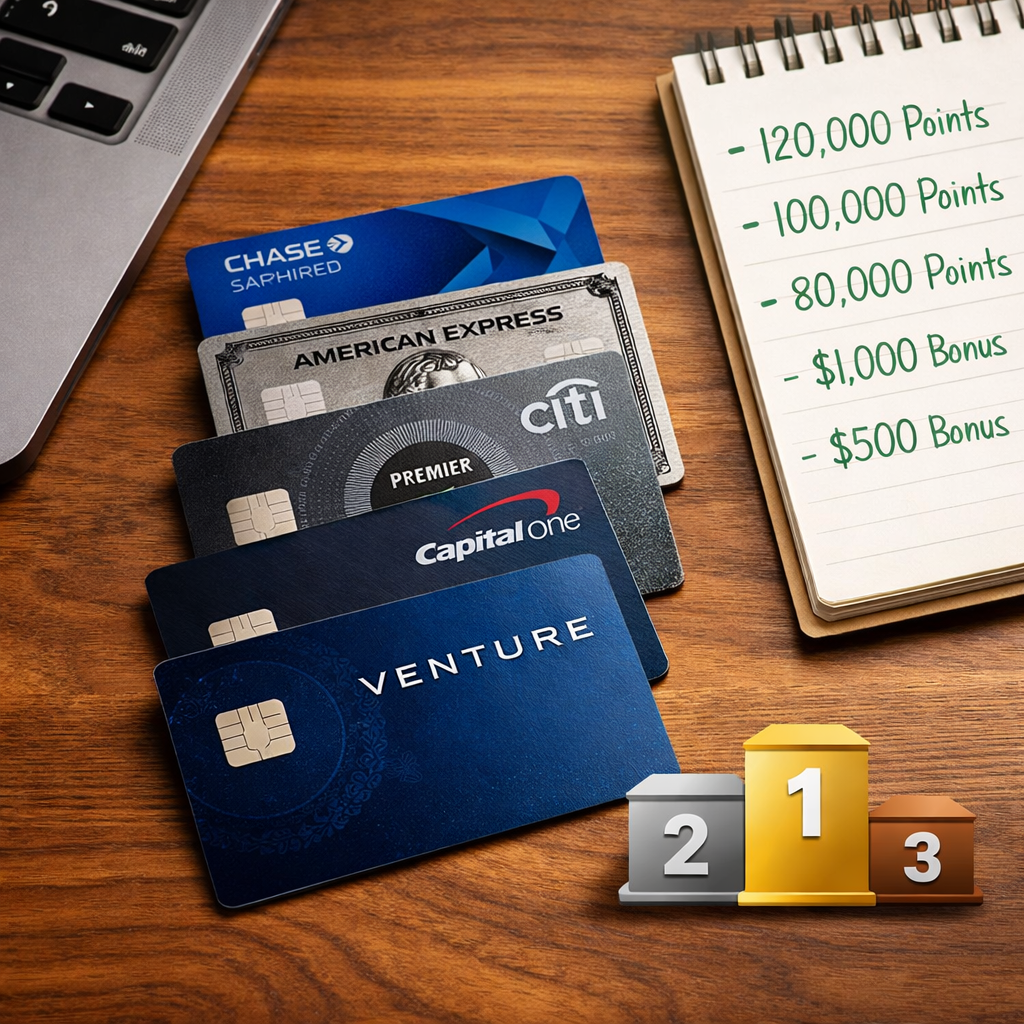
Top issuer points credit cards with generous welcome bonuses, ranked
Top issuer points credit cards with generous welcome bonuses, ranked
Looking for the best points earning credit cards with welcome bonuses that are actually easy to use? At Points and Perks Guide, we ranked the top issuer and co‑brand options by headline bonus, transfer flexibility, and credits you’ll likely redeem—so you can pick a high‑value offer without overspending. Executive summary: Capital One Venture X leads for net value plus lounges and transferable points; Chase Sapphire Preferred is the best low‑fee entry to flexible travel rewards; Amex Platinum ranks for oversized bonuses and unmatched lounge/credit depth. The tradeoff is simple—bigger bonuses and perks typically come with higher annual fees; the right pick is the one whose credits and transfer partners match your travel.
Comparison snapshot (offers vary over time):
| Card | Indicative welcome offer (current/past) | Min. spend & timeline | Annual fee | Key credits | Lounge access | Transfer flexibility | Who should choose it |
|---|---|---|---|---|---|---|---|
| Capital One Venture X | 75,000 miles; historically strong offers reappear | $4,000 in 3 months | $395 | $300 Capital One Travel; 10k anniversary miles | Capital One Lounges + partner networks | Miles transfer to airline/hotel partners | Premium value with simple redemptions and lounges |
| Chase Sapphire Preferred | 60,000–75,000 points typical | $4,000 in 3 months | $95 | $50 hotel credit via Chase Travel; 10% anniversary points boost | Priority Pass Select (limited via add‑ons/combos) | Ultimate Rewards transfer to multiple partners | Low-fee starter for transferable points |
| American Express Platinum | 100,000+ MR seen historically | $10,000 in 6 months | $695 | Airline/airline‑fee, hotel, Uber, Saks, Equinox, and more (activation required) | Amex Global Lounge Collection (1,550+ lounges as of 07/2025) | MR points transfer broadly to airlines/hotels | Lounge-first luxury travelers maximizing credits |
| American Express Gold | Typically strong 60k–90k+ MR offers | $4,000 in 6 months | $325 | Uber Cash, dining credits (activation/app required) | No proprietary lounge | MR transfer partners | Food‑first earners (restaurants/supermarkets) |
| Chase Sapphire Reserve | Six‑figure bonuses have appeared (e.g., 100k–125k in select periods) | ~$4,000–$6,000 in 3 months | $550 | $300 travel credit; DoorDash/Instacart/Peloton promos vary | Priority Pass lounges & restaurants (enrollment required) | Full UR transfer power | Premium protections with richer credits |
| Marriott Bonvoy Boundless | Three free nights after $3,000/3 months seen | $3,000 in 3 months | ~$95 | Annual free night certificate | N/A | Co‑brand points (less flexible) | Marriott loyalists with near‑term stays |
Points and Perks Guide
We rank fast and fairly—stop guessing, start earning. Our five‑minute decision flow weighs headline bonus, redemption flexibility (transfer partners matter), recurring credits, and real‑user redemption evidence. We update rankings as offers change and help you sequence applications: map your last 24 months of new accounts and prioritize Chase approvals first to preserve odds and build a flexible ecosystem. Our flow bakes in common issuer rules so you apply in the optimal order.
For structured discovery, tag cards with credit and earning and bookmark our guide to transferable travel rewards cards for tactics to “earn once, redeem anywhere”: https://www.pointsandperksguide.com/posts/earn-once-redeem-anywhere-best-transferable-travel-rewards-cards/ and our tags pages: credit (https://www.pointsandperksguide.com/tags/credit/) and earning (https://www.pointsandperksguide.com/tags/earning/).
How we ranked the top welcome bonus cards
A welcome bonus is the one‑time haul of points or miles you earn for meeting a card’s minimum spend within a set window. Real value blends the headline size with how achievable the spend is, whether the points transfer to strong partners, and how recurring credits offset the annual fee.
What we weighed most:
- Transfer partners and flexible redemption power—general‑purpose points that move to airline/hotel programs can unlock outsized value, including premium cabins and partner awards (see Bankrate’s best rewards card guide for why flexibility wins): https://www.bankrate.com/credit-cards/rewards/best-rewards-cards/
- Recurring credits that reduce net cost, like the Chase Sapphire Preferred’s $50 annual hotel credit and anniversary point boosts, and Venture X’s $300 travel credit (per TPG’s 2025 roundup): https://www.thepointsguy.com/credit-cards/stephanie-stevens-best-rewards-credit-cards-nov25/
- Verification sources for current bonus ranges and perks: Points and Perks Guide (live offer tracking), TPG (valuations and credits), Kiplinger (historical offer context): https://www.kiplinger.com/personal-finance/credit-cards/best-rewards-credit-cards, NerdWallet (earn structures): https://www.nerdwallet.com/credit-cards/best/rewards, and Bankrate (flexibility/lounges).
Quick rules before you apply
- Sequence smartly: Map the last 24 months of accounts and start with Chase to align with common bank rules; then diversify. Our five‑minute decision flow keeps you on track.
- Budget fit over headlines: A 75k–100k bonus is great only if the spend fits your existing budget; premium cardholders report higher satisfaction when benefits clearly exceed costs, even with bigger fees (J.D. Power 2025): https://www.jdpower.com/business/resources/top-credit-card-issuer-trends-2025-whats-happening-now-and-whats-next
- Use credits you’ll actually redeem: Examples include the Venture X’s $300 Capital One Travel credit and Sapphire Preferred’s $50 hotel credit (per TPG).
1. Capital One Venture X
Venture X tops our list for repeatable welcome value, transferable miles, premium credits, and broad lounge access at a compelling net cost. A frequent 75,000‑mile offer after $4,000 in 3 months pairs with valuations around ~$1,388 for the bonus alone, based on TPG’s cents‑per‑mile methodology; historically stronger public and targeted offers have cycled back into market: https://www.thepointsguy.com/credit-cards/stephanie-stevens-best-rewards-credit-cards-nov25/
Annual value stack: $300 Capital One Travel credit plus 10,000 anniversary miles (valued near $185 at the same rate) materially offset the $395 fee. Simple redemptions via portal and robust airline/hotel transfer partners make it easy to capture value beyond year one.
Who it’s for:
- Travelers who want a “set‑and‑save” card with lounges and transferable miles
- Households able to naturally hit $4,000/3 months without stretching
- Anyone seeking strong net value without juggling multiple premium cards
2. Chase Sapphire Preferred
Sapphire Preferred is our favorite low‑fee entry to transferable points. For $95, you get a $50 annual hotel credit via Chase Travel and a 10% points anniversary boost, keeping net cost low in most years (per TPG). Earning is straightforward: 5x on travel booked via Chase Travel and 3x on dining, select streaming, and online grocery per NerdWallet’s current profile: https://www.nerdwallet.com/credit-cards/best/rewards
Practical perks include primary rental car coverage and flexible award pathways highlighted in popular card strategy commentary; approval odds often begin around the high‑600s (~690) for well‑qualified applicants per that on‑camera guidance: https://www.youtube.com/watch?v=hMu5t1aAXiM
3. American Express Platinum
Amex Platinum ranks for oversized bonuses and unparalleled lounge/credit depth—if you can use them. A prior 100,000 Membership Rewards offer after $10,000 in 6 months carried an illustrative ~$1,850 valuation in TPG’s late‑2025 analysis. You’re buying access and protections: the American Express Global Lounge Collection spans 1,550+ lounges as of 07/2025, plus rich airline, hotel, Uber, Saks, and wellness credits (activation and enrollment often required).
Earning sweet spots include 5x on flights and prepaid hotels booked via Amex Travel, while MR transfers open premium‑cabin award opportunities when you plan around partner sweet spots.
4. American Express Gold
Gold is the food‑first workhorse that still brings strong welcome bonuses. Recent coverage pegs the annual fee at $325, with easy‑to‑use statement credits like $120 in Uber Cash and dining‑focused benefits (enrollment/app required), alongside 4x points at restaurants and U.S. supermarkets (with issuer caps)—a natural fit for everyday spend: https://www.youtube.com/watch?v=IiK5CbSdGSA
Use cases: maximize grocery and dining to build a big MR balance fast, then pair with partner transfers for flights or with portal bookings when cash prices are low.
5. Chase Sapphire Reserve
Sapphire Reserve is the premium UR pick when you want richer protections and credits with a heavier welcome. Six‑figure bonuses have appeared historically (100k at launch and as high as 125k in select windows), though availability varies by time and channel; the annual fee is offset by a broad, easy‑to‑use $300 travel credit and elevated travel protections (per Kiplinger’s best rewards roundup): https://www.kiplinger.com/personal-finance/credit-cards/best-rewards-credit-cards
Quick CSP vs. CSR contrast:
- Fee: $95 vs. $550
- Credits: $50 hotel credit vs. $300 flexible travel
- Lounge: Limited (via combos) vs. Priority Pass (enrollment required)
- Bonus trajectory: CSP sees frequent public boosts; CSR’s spikes are rarer but larger when they appear
6. Marriott Bonvoy Boundless
A co‑brand can outrank generalist cards when the welcome maps directly to planned stays. Boundless has offered three free nights after $3,000 in 3 months, and carries an annual free night certificate that can neutralize the modest fee if used well (offers vary by time): https://www.kiplinger.com/personal-finance/credit-cards/best-rewards-cards
Co‑brand cards are issued with a specific travel program; they earn points and perks tied to that brand. Value can be excellent for loyalists and near‑term trips, but points are less flexible than general‑purpose currencies that transfer to many partners.
Fit checklist:
- Loyal to Marriott with near‑term hotel plans
- Comfortable optimizing off‑peak/standard charts and top‑offs
- Will use the annual free night certificate every year
How to choose based on your goals
Our five‑step decision flow:
- Budget reality: confirm you can hit the minimum spend with existing expenses.
- Travel frequency: frequent flyers benefit more from lounges and protections.
- Transfer partner fit: pick ecosystems whose partners match your routes.
- Credits you’ll use: only count credits you’ll reliably redeem.
- Application sequencing: map 24 months and prioritize Chase approvals first.
Decision mapping:
- Lounge + easy $300 travel credit use → Choose Venture X (credits and anniversary miles consistently offset fee; TPG valuations underscore strong net).
- Low fee + flexible points → Choose Sapphire Preferred (includes $50 hotel credit and broad 3x categories).
- Luxury lounges + deep credits → Choose Amex Platinum (Global Lounge Collection depth).
- Dining/grocery heavy spending → Choose Amex Gold (4x earn makes bonuses and ongoing value stack).
- Premium protections + UR ecosystem → Choose Sapphire Reserve (bigger credits, rarer big bonuses).
- Marriott stays planned soon → Choose Bonvoy Boundless (free‑night packages tie directly to trips).
If you’re torn between two, our five‑minute flow translates these tradeoffs into a single pick.
Maximizing a welcome bonus without overspending
- Audit the last 90 days of expenses to size a realistic spend plan.
- Redirect recurring bills (cell, internet, streaming, insurance) to the new card.
- Prepay utilities/insurance where allowed to accelerate progress.
- Time large planned purchases (travel, appliances) within the bonus window.
- Add an authorized user for household spend you already make.
- Avoid interest—pay in full monthly so rewards aren’t erased by finance charges.
Minimum spend requirement: the amount you must charge in a defined timeframe (e.g., $4,000 in 3 months) to earn the bonus; it excludes cash advances, certain payments, and returns per issuer terms. Note that premium cardholders tolerate higher fees when value is clear—even as more consumers show financial strain—so practice strict budget discipline (J.D. Power 2025).
Methodology and value assumptions
We used public valuations to contextualize offers, including TPG’s estimates of Venture X 75k ($1,388) and Amex Platinum 100k ($1,850). Real‑world transfer evidence matters: for example, moving 15,000 points during a 25% Chase–Flying Blue bonus for a D.C.–Paris itinerary otherwise priced above $600 illustrates partner power cited in the same coverage. Offers change frequently, credits often require activation or booking through issuer portals, and valuations depend on redemption style; in general, transferable points can unlock outsized value via airline/hotel partners (as summarized by Bankrate). We also cross‑checked card details against Points and Perks Guide’s live offer posts.
Frequently asked questions
What makes a welcome bonus truly valuable beyond the headline points?
Flexibility, achievable minimum spend, and credits you’ll actually redeem. Points and Perks Guide prioritizes strong transfer partners and usable credits over raw headline size.
How hard is it to meet minimum spend without changing my budget?
If you redirect existing bills and time planned purchases, typical thresholds like $3,000–$4,000 in 3 months are manageable—just plan ahead and pay in full. Our five‑minute decision flow helps you map spend timing.
Do high annual fees negate the value of a big bonus?
Not if recurring credits and perks reliably offset the fee. Points and Perks Guide’s picks assume you’ll only count credits you can actually use.
Should I prioritize transferable points over co‑brand points?
Usually yes for flexibility and premium flight redemptions; in our rankings, transferable ecosystems typically come out ahead.
Will applying for multiple cards hurt my approval odds later?
Yes—if you ignore sequencing. Use Points and Perks Guide’s sequencing rules to map the last 24 months and prioritize key issuers first to preserve approval odds.