How to Pick Frequent Flyer Credit Cards for Fast Points
How to Pick Frequent Flyer Credit Cards for Fast Points
Earning points quickly starts with choosing the right card for your next trip, not the other way around. If you mostly fly one airline and value perks like free bags, a co-branded airline card can accelerate your balance and cut fees. If you mix carriers or want premium-cabin awards, a transferable-points card usually earns faster and redeems smarter across partners. Transferable points — credit card rewards that move to multiple airline and hotel partners (e.g., Chase, AmEx, Citi, Capital One) — increase flexibility and can yield higher-value redemptions because you can pick the best partner at booking time, as summarized in NerdWallet’s guide to points and miles. NerdWallet beginner guide At Points and Perks Guide, we generally recommend starting with transferable points unless you’re hub-captive to one airline.
Use the quick flow below to match a card type, grab a strong welcome offer you can meet, and point your spending at the right bonus categories and tools to redeem fast.
Define your travel goal and timeline
Set a destination, cabin (economy/premium/business), and date window first; clear goals keep you from collecting the wrong points. Choosing attainable, near-term awards also maintains motivation and reduces churn, a best practice echoed in The Points Guy’s beginner primer. TPG’s beginners guide
Use this three-step micro-flow:
- Estimate points needed using award search tools and a couple of date options.
- Map timing to welcome offer windows (most require minimum spend within 3–6 months).
- Plan a top-up strategy with bonus categories and shopping/travel portals to close any gap.
Goal-to-card strategy at a glance:
| Trip type | Point target range (per person unless noted) | Best card type | Why | Tools to validate availability |
|---|---|---|---|---|
| Domestic economy roundtrip (one-airline hub) | 15k–40k | Co-branded airline card | Free bags, priority boarding, reliable earn with one carrier | Airline calendar + Seats.aero (near-term) |
| Domestic/short-haul, mixed carriers | 20k–50k | Transferable points | Pivot to whichever partner prices lowest on your dates | Point.me multi-partner search |
| Family trip (3–4 travelers) to Hawaii/Caribbean, peak | 80k–200k+ total | Two transferable cards (+ optional co-brand) | Stack welcome offers; use co-brand for bag savings | Award alerts + bank travel portal pricing |
| Business class to Europe (one-way) | 120k–180k | Transferable points | Partners often price better than your home airline | Point.me + alliance partner calendars |
Note: Some tools provide comprehensive award flight searches and alerts to simplify booking with points. Bankrate’s overview of redemption tools
Choose card type by strategy
Co-branded airline card — a credit card issued with an airline that earns that airline’s miles and unlocks airline-specific perks like free checked bags, priority boarding, and sometimes companion fares. Best for loyalists on one carrier.
Transferable-points card — a bank card earning points transferable to multiple airline/hotel partners for flexible, potentially higher-value redemptions.
At Points and Perks Guide, most travelers earn fastest by starting with one flexible currency and layering a co-branded card only when perks like free bags will get used.
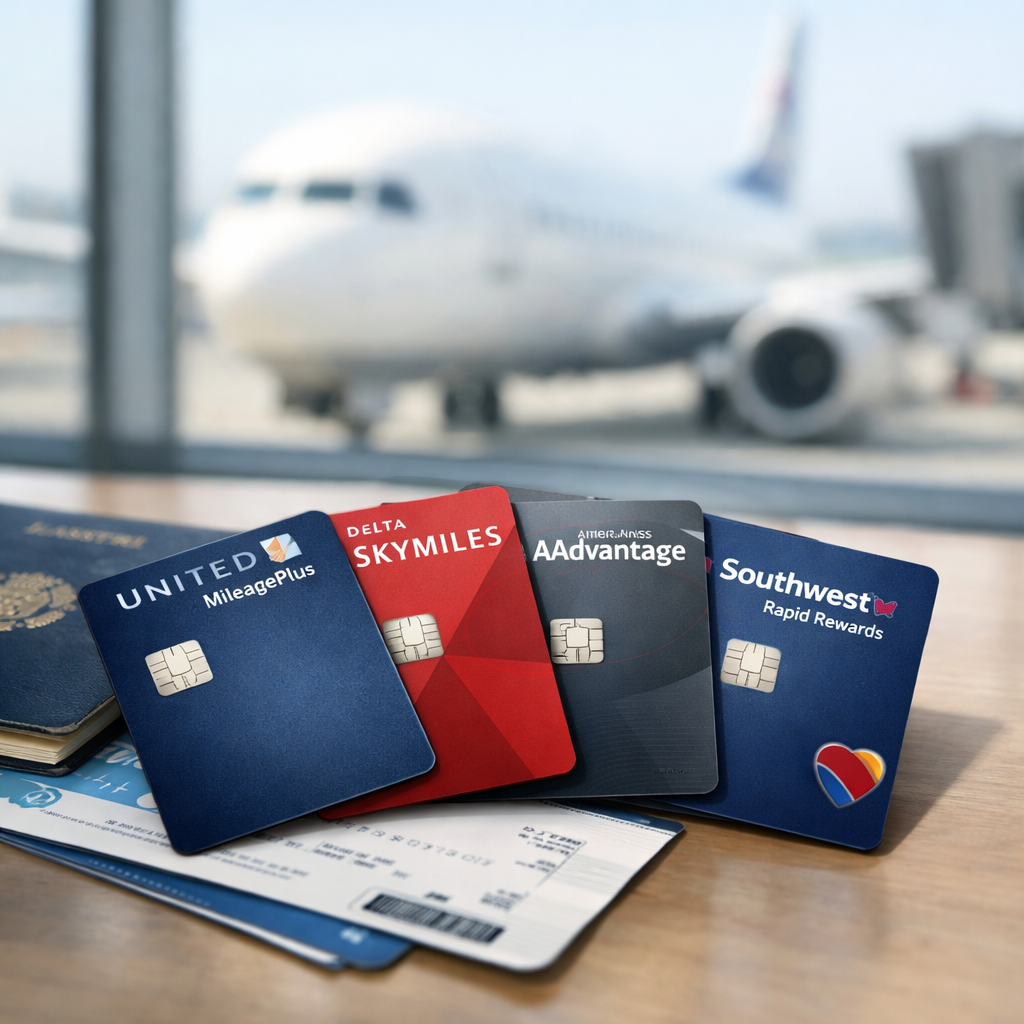
Co-branded airline cards for loyalists
Pairing your airline loyalty program with its co-branded card stacks mileage earnings and perks, accelerating balances through welcome bonuses and category multipliers. Faster-earning loyalty strategies
Concrete examples of why they’re compelling:
- Delta: SkyMiles don’t expire; co-branded cards earn on everyday spend and offer priority perks.
- United: MileagePlus sits in Star Alliance, broadening partner award options.
- Alaska: Popular companion fare and free checked bags on many Visa Signature versions. A broad program overview of these advantages can be found in Blacklane’s guide to major frequent flyer programs. Guide to major frequent flyer programs
Elite boosters matter too: status-driven upgrades, extra baggage, and priority services improve trip value beyond the miles themselves.
When co-branded wins:
- You live in a single-airline hub or consistently fly one carrier/alliance.
- You pay frequent bag fees and will use the free-bag perk.
- You can redeem a companion fare at least once a year.
- You’re pursuing elite-qualifying benefits.
Transferable points cards for flexibility
Chase, American Express, Citi, and Capital One points transfer to multiple airline and hotel partners, and this flexibility often boosts redemption value versus earning a single-airline currency. (See the transferable-points overview in NerdWallet linked above.) Use flexible points to pivot when award space shifts — and transfer only after you confirm seats.
Example of a fast-earner that offsets its fee with travel value: Capital One Venture X includes a $300 annual travel credit, 10,000 anniversary points, a Global Entry/TSA PreCheck credit, and lounge access/Priority Pass, which can more than neutralize the annual fee for frequent travelers. We expand on this in the fee-value section below.
Quick picks by traveler type:
- Solo, mix of carriers: Transferable points to chase the lowest award pricing.
- Family planners: Two transferable cards for stacked bonuses; add a co-brand if bag savings recur.
- Airline loyalist with routine bag fees: Co-branded card for perks and steady earn.
For deeper tactics on flexible currencies, see our transferable-currency strategy guide. Transferable-currency strategy
Prioritize welcome offers and minimum spend
Welcome bonuses are the fastest way to grow balances; a single offer can dwarf months of everyday earning when you meet the minimum spend in time. How loyalty programs turbocharge earn Paired with the fundamentals in NerdWallet’s primer, this is the cornerstone of earning fast. NerdWallet’s guide to points and miles
Spend-planning checklist:
- Map fixed monthly bills (rent, utilities, insurance) that can be paid by card.
- Time large planned purchases inside the 3–6 month bonus window.
- Leverage reimbursable work travel.
- If short, top up with online shopping portals and bonused categories.
Rule of thumb: Pick a welcome offer that covers 60–80% of the points for your target trip within your 3–6 month timeline, validated by award search tools and cash-versus-points comparisons. Bankrate’s redemption tools overview
Match earning categories to your real spend
Bonus category — a purchase type (e.g., dining, travel, airfare) where a card awards extra points (like 3X–5X). Maximizing spend in these buckets compounds earnings versus 1X non-bonused purchases.
Audit your last 90 days of spend across airfare, hotels, dining, groceries, gas, transit/rideshare, and online shopping. Then choose cards whose multipliers align with the top three categories. Remember: card points can be redeemed for airfare, hotels, statement credits, or gift cards, but travel redemptions typically deliver the best cents-per-point value. TPG’s beginners guide
Category-to-earning ideas:
| Spend category | Best earning options | Notes |
|---|---|---|
| Airfare direct with airline | Co-branded airline card (often 2x+) or premium transferable card that bonuses travel (3x–5x) | Booking direct preserves airline perks/status earning; stack with loyalty accrual |
| Hotels | Transferable cards with elevated travel multipliers or portal rates | Compare bank portal rates vs paying direct for elite credit/benefits |
| Dining & delivery | Transferable cards commonly at 3x–4x | Layer card-linked offers for extra rebates |
| Groceries | Select transferable cards with 4x–5x caps; otherwise 1x–2x | Use quarterly or rotating-category boosts if available |
| Gas, transit, rideshare | Transferable cards with 3x; some co-brands bonus rideshare | Add rideshare promos when targeted |
| Online shopping | Any card + cashback or airline shopping portal | Portal stacking can add 2x–10x in portal points/miles |
Weigh annual fees against credits and perks
High-annual-fee cards can be net positive if recurring credits, anniversary points, and time-saving perks offset costs. Practical fee-offset example
Case study: Venture X’s $300 annual travel credit, 10,000 anniversary points, Global Entry/TSA credit, and lounge access/Priority Pass can exceed the fee for frequent travelers who book even one or two trips per year.
Quick net-value check:
- Annual fee
- Minus recurring credits (travel, airline, dining), plus anniversary points
- Minus realistic perk value you’ll actually use (free bags, companion fare, lounge visits, trip protections) = Net cost. If near zero or negative, keep; if positive and underused, downgrade.
Perks that save time/money:
- Free checked bags
- Priority check-in/security and early boarding
- Lounge access (food, Wi-Fi, workspace)
- Companion fares
- Trip protections (delay/cancellation, primary rental car coverage)
Plan tools and tracking for faster redemptions
Award availability alert — a notification that flags when seats bookable with points open on your route so you can transfer and book before space disappears. Some tools provide comprehensive award searches and alerts that compress the research and booking process. Bankrate’s overview of redemption tools
Award search and alerts
- Seats.aero: Quick, free scans of near-term award space (often within 90 days).
- Point.me: Finds complex international partner routings you might miss.
- Thrifty Traveler Premium: Push alerts for award deals and occasional mistake fares. A concise roundup of these tools and more is here: best points and miles tools.
Suggested workflow: Set route/date alerts → price awards vs cash → hold/confirm space → transfer points → book → organize confirmations in a trip app like TripIt.
Card bonus and rule trackers
- CardPointers helps you pick the right card at checkout to maximize category multipliers.
- Travel Freely tracks annual fees, welcome bonuses, and your 5/24 status to time applications.
- Pro tip: Enroll in the big loyalty programs (it’s free) and link them in your tools so balances auto-log and you can transfer quickly when alerts hit.
Protect your credit and issuer rules
5/24 rule — an informal issuer policy that often declines applications if you’ve opened five or more personal cards in the past 24 months. Apps like Travel Freely make it easy to track this alongside renewal dates.
Best practices:
- Pay in full every month and keep utilization low.
- Time applications around big, planned expenses so you can meet minimum spend efficiently.
- Pace applications and diversify across issuers to preserve future eligibility.
- Favor transferable currencies to maintain redemption flexibility.
Quick decision flow for fast picks
- Define destination, cabin, and dates.
- Check award space with Seats.aero and Point.me; confirm it’s feasible.
- Choose card type: co-branded for one-airline loyalty/perks; transferable for flexibility/partners.
- Pick the strongest welcome offer you can meet within 3–6 months.
- Match category multipliers to your top three spend buckets.
- Track minimum spend and 5/24 with Travel Freely/CardPointers; set award alerts.
If this, then that:
| Situation | Fast pick |
|---|---|
| Fly Delta often and check bags yearly | Delta co-branded card for free bags/priority; add a transferable card later for partner reach |
| Mix carriers or plan international awards | Premium transferable card (e.g., one with lounge access and a $300 travel credit) for flexible transfers |
| Booking a family trip in 6 months | Two solid transferable-card welcome offers; consider one co-brand for bag savings |
| Want elite-like perks without status | Co-branded card offering priority boarding and a companion fare |
| Not sure which airline you’ll fly | Transferable points to pivot to the best partner when space appears |
Ready to pick? See our expert-vetted best cards for 2026 to start strong, then pair with a flexible currency if you split airlines. Best cards for high points, expert picks
Frequently asked questions
Do I pick a co-branded airline card or a transferable points card?
Choose a co-branded airline card if you mostly fly one carrier and value perks like free bags and priority boarding; pick transferable points if you want partner flexibility and the ability to chase the best award space. Points and Perks Guide generally recommends starting with transferable points unless you’re hub-captive.
How big should a welcome offer be to be worth it?
Aim for an offer that covers 60–80% of the points you need for your next trip and that you can meet without overspending after checking award prices. Our picks favor offers that hit that threshold on realistic spend.
What spend categories earn points fastest for most travelers?
Travel and dining commonly offer strong multipliers, but audit 90 days of your own spending and choose cards that bonus your biggest categories. Points and Perks Guide focuses on practical, high-usage categories.
Are premium cards worth the annual fee for earning points quickly?
They can be if recurring credits, lounge access, and anniversary points offset most or all of the fee and you travel often; run a simple fee-minus-credits calculation. Our guides show this math so you can sanity-check value.
How do issuer application rules affect my card strategy?
Rules like 5/24 can limit approvals if you’ve opened many cards recently, so time applications around big expenses and track your status to avoid missing bonuses. Points and Perks Guide’s decision flows help you pace applications.