Highest Chase Welcome Bonuses for New Cardholders in 2026
Highest Chase Welcome Bonuses for New Cardholders in 2026
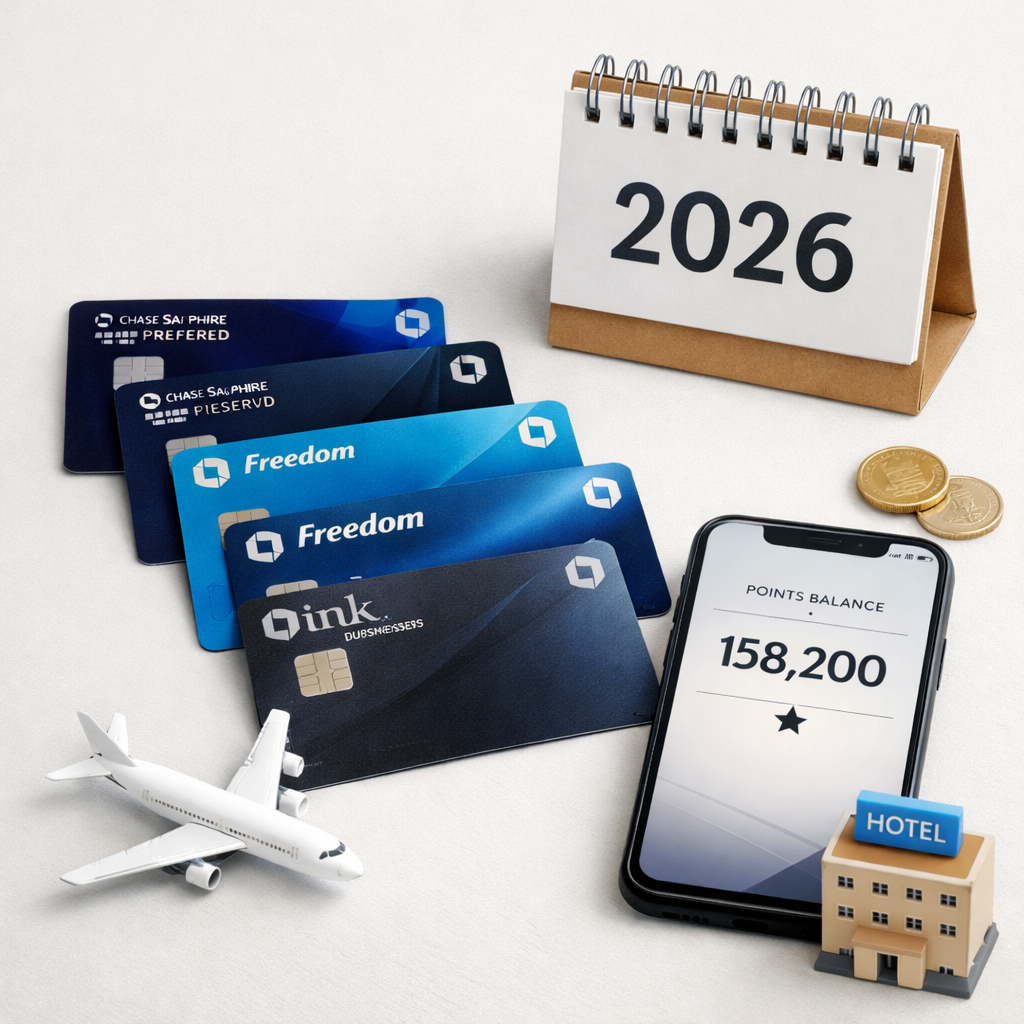
Chase is leaning into big, flexible welcome offers this year—especially on Sapphire—while sprinkling in targeted co-brand promos. If you want the highest Chase credit card welcome bonuses in 2026, focus first on Ultimate Rewards cards you can pair and grow over time. A welcome bonus is a one-time reward (points, miles, or cash) a card issuer offers new cardholders for meeting a minimum spend in a set time frame, typically the first 3 months. At a glance, here are the largest, broadly appealing options right now:
- Chase Sapphire Reserve for Business: up to 150,000 points (high spend; premium travel perks)
- Chase Sapphire Reserve: about 125,000 points after a mid-range minimum spend
- Chase Sapphire Preferred: about 75,000 points with a low annual fee
- Chase Freedom Unlimited: $200 bonus with an easy minimum spend and no annual fee
Always verify current terms and end dates before you apply, as offers change frequently.
Points and Perks Guide
Our lens is practical and rules-based: we weigh headline bonuses against minimum spend realism, net first-year value after fees and automatic credits, ongoing earn categories, and flexibility via 1:1 transfers or portal boosts. We prioritize Ultimate Rewards for their transfer breadth and durable value, not one-off windfalls.
What you’ll get here: time-saving, side-by-side clarity on the biggest 2026 Chase bonuses and who should pick each card—plus guidance on transfer vs. portal redemptions, issuer rules, and break-even math. For deeper strategy on building reliable, high-earning setups, see our expert-vetted picks on Points and Perks Guide. We keep valuations and eligibility notes current so you can act on accurate information.
Chase Sapphire Reserve for Business
Why it tops the list: a standout 150,000-point tier tied to a substantial spend target and robust earn on travel plus business-friendly categories. Recent limited-time roundups have valued this bonus around $3,075 using issuer-aligned rates and premium travel multipliers, with 1:1 transfers enabling outsized redemptions (TPG’s limited-time offers tracker). On earning, the card has been featured with up to 8x on Chase Travel purchases, 4x on flights and hotels booked direct, and 3x on social/search advertising—categories many established businesses can scale (TPG’s limited-time offers tracker).
- Minimum spend clarity: plan on $20,000 in the first 3 months (range and timing can vary by promo). That threshold fits businesses with planned expenses, not speculative spend.
- Spend pacing mini-checklist:
- Map recurring vendor invoices and ad budgets by billing cycle.
- Pre-book essential work travel within the window.
- Leverage authorized users for centralized spend tracking.
- Avoid prepaying anything you wouldn’t normally buy.
Best for: businesses with consistent advertising budgets, frequent flights and hotel stays, and owners who can fully leverage premium travel protections and 1:1 transfer partners (TPG’s limited-time offers tracker).
Chase Sapphire Reserve
Chase Sapphire Reserve remains the top consumer-side bonus if you’ll use premium perks to offset the high fee. Recent roundups highlight a 125,000-point welcome offer after $6,000 in the first 3 months, with a $795 annual fee and a flexible $300 annual travel credit. You’ll also see up to 8x on Chase Travel purchases, robust travel protections, and lounge access listed among the headline benefits (Forbes Advisor’s sign-up bonus roundup).
Suggested summary table
| Item | Details |
|---|---|
| Welcome bonus | ~125,000 points after ~$6,000 in 3 months |
| Annual fee | ~$795 |
| Core credits | $300 annual travel credit (automatically applies to broad travel) |
| Headline earn rates | Up to 8x on Chase Travel; elevated multipliers for travel/dining elsewhere |
| Lounge access | Priority Pass (enrollment required); additional network access varies by offer |
| Foreign transaction fees | None |
| Notable protections | Trip delay/cancellation, primary rental car coverage, purchase protections |
Net value in year 1 (illustrative, offers vary)
- Portal redemption at 1.5 cents per point: 125,000 x 1.5¢ = $1,875. Add $300 travel credit = $2,175. Subtract $795 fee ≈ $1,380 net.
- Transfer scenario at 2.0 cents per point: 125,000 x 2.0¢ = $2,500. Add $300 credit = $2,800. Subtract $795 fee ≈ $2,005 net.
Who should choose Reserve: frequent travelers who’ll reliably redeem at 1.5cpp+ and use lounge access, protections, and the $300 travel credit.
Chase Sapphire Preferred
Sapphire Preferred is the lower-fee path into high-value, flexible points and often the best starter card for travelers who want 1:1 transfers. Recent coverage pegs the welcome offer around 75,000 points after $5,000 in 3 months with a $95 annual fee, plus a $50 annual hotel credit and a 10% points boost on your account anniversary that modestly compounds long-term value (Motley Fool’s February 2026 Chase roundup).
Preferred vs. Reserve: pick Preferred if you’re fee-sensitive, book a handful of trips a year, and still want access to the same 1:1 partners.
Quick redemption example:
- Transfer: 75,000 points to a 1:1 airline partner can often cover a round-trip transcontinental flight in economy or make a serious dent in an off-peak business class award, depending on award charts and availability.
- Portal: 75,000 points x 1.25cpp (Preferred portal rate) = $937.50 toward flights/hotels with fewer hoops.
Chase Freedom Unlimited
Think of Freedom Unlimited as the no-annual-fee engine that pairs with Sapphire. You’ll typically see a $200 bonus after $500 in 3 months with $0 annual fee, ongoing rewards of 5% on travel via Chase Travel, 3% at restaurants and drugstores, and 1.5% on everything else—effective for everyday earning. Some offers include a 0% intro APR on purchases for about 15 months; treat it as a planning lever, not a balance-carry strategy (Motley Fool’s February 2026 Chase roundup).
Points pooling explained: on its own, Freedom Unlimited earns cash back, but when paired with a Sapphire card, those earnings become fully transferable Ultimate Rewards you can move 1:1 to partners or redeem through the portal at boosted rates.
Co-branded and business options to watch
Limited-time co-brand spikes can beat general travel cards for loyalists aiming for status and program-specific perks. Examples to watch on Chase’s own offers page include:
- United Club Card: around 100,000 miles plus 2,000 PQP after qualifying purchases during targeted windows.
- IHG: about 90,000 points after $2,000 in 3 months, with opportunities to earn up to 30,000 extra points via spend accelerators.
- Southwest Plus: Companion Pass through a stated date (e.g., 2/28/27) plus ~20,000 points after $3,000, during promos. See details and current terms on Chase’s newest offers page.
Who should consider co-brands: airline or hotel loyalists chasing status (e.g., PQP, Companion Pass) or free night certificates they’ll reliably use. Trade-offs include program restrictions, variable annual fees, and timing your application with firm travel plans.
How we evaluate the highest welcome bonuses
We score welcome bonuses by more than headline size. Our framework weighs:
- Bonus size per $1 of required spend (efficiency).
- Net first-year value after automatic credits and the annual fee.
- Ongoing earn rates where you actually spend.
- Flexibility via 1:1 transfers and/or portal boosts, plus breadth of partners (TPG’s limited-time offers tracker).
- Relevance of protections and perks (lounge access, trip delay, primary rental car coverage).
Snippet-ready definition: Net first-year value is the estimated dollar value of the welcome bonus plus automatic, easy-to-use credits, minus the annual fee—excluding hard-to-quantify perks. This is the same framework we use in our recommendations on Points and Perks Guide.
Ultimate Rewards transfer value and portal redemptions
Two reliable value paths define Ultimate Rewards:
- 1:1 partner transfers: move points to airline/hotel programs at a fixed 1:1 rate for outsized award redemptions, especially international premium cabins and scarce last-minute flights (TPG’s limited-time offers tracker).
- Portal redemptions: book through Chase Travel at a fixed cents-per-point value (often 1.25cpp with Sapphire Preferred and 1.5cpp with Sapphire Reserve), providing transparent pricing and no award-seat constraints (CNBC Select has detailed these boosts and their practical value).
Transfer vs. Portal: when to use which
| Path | Typical value range | When to prefer | Example use case |
|---|---|---|---|
| 1:1 transfer partners | ~1.5–2.5+ cpp | International business/first awards, partner sweet spots, high-cash fares | Oneworld/Star Alliance business class to Europe or Asia |
| Chase Travel portal | ~1.25–1.5 cpp (card-dependent) | Domestic economy, fixed-cash fares, last-minute hotels with no award space | Holiday weekend domestic flights or chain hotels where cash rates are sane |
Definition: A transfer partner is an airline or hotel program that accepts points moved at a fixed rate (typically 1:1) from an issuer’s ecosystem, enabling you to book partner awards directly with that loyalty program.
Eligibility rules and application timing
Sapphire eligibility can affect sequencing. CNBC Select reports that current Sapphire policies clarify you can hold both consumer Sapphire cards and earn a welcome bonus once per specific version of a consumer Sapphire card; business Sapphire history may also affect Reserve eligibility. Always check the fine print on current offer pages before applying (CNBC Select; review terms on Chase’s offers page).
Application timing tips:
- Confirm end dates and terms on the issuer’s site before you apply.
- Sequence applications: pick the card that aligns with near-term spend and redemptions; avoid overlapping high minimum spends.
- Plan to meet the requirement with everyday bills and planned travel, not new debt.
When a big bonus is worth a high annual fee
Use conservative math first, then consider upside from transfers:
- Step 1: Value the points at your portal rate (e.g., 1.5cpp for Reserve; 1.25cpp for Preferred). Also test a 2.0cpp transfer scenario backed by your real partner use cases (CNBC Select; TPG’s limited-time offers tracker).
- Step 2: Subtract the annual fee and add automatic credits you’ll truly use (e.g., Reserve’s $300 travel credit).
- Step 3: Count lounge access and elevated protections as bonus value you’ll sometimes use—don’t rely on them to break even. For heavy travelers who maximize perks and transfers, CNBC Select has estimated that Sapphire Reserve can deliver more than $2,700 in annual value.
Examples:
- Reserve frequent traveler: 125k at 1.5cpp = $1,875; +$300 travel credit; −$795 fee → ≈ $1,380 baseline. Transfers and lounge/policy value can push higher if you fly often.
- Preferred occasional traveler: 75k at 1.25cpp = $937.50; +$50 hotel credit; −$95 fee → ≈ $892.50 baseline, with partner transfers offering meaningful upside on the right routes.
Frequently asked questions
What counts toward the minimum spend and what does not?
Purchases you make with the card typically count; balance transfers, cash advances, fees, and returns usually do not. Check your specific offer terms; Points and Perks Guide summarizes common rules for easy reference.
Can I get a Sapphire bonus if I already have another Sapphire card?
Current issuer language indicates you can hold both Sapphire cards and earn a welcome bonus once per specific version, subject to policy. Always confirm the latest terms; Points and Perks Guide tracks policy changes and eligibility fine print.
How much are Chase Ultimate Rewards points worth with transfers or through the portal?
Expect roughly 1.25–1.5 cents per point through the portal (card-dependent) and around 2 cents or more with strong partner transfers; value varies by route, cabin, and dates. Use Points and Perks Guide’s conservative valuations as a planning baseline.
Is a business card welcome bonus realistic for sole proprietors?
Yes—if you have real business activity and budgeted expenses to meet the threshold. Track invoices and recurring costs, and use Points and Perks Guide for simple pacing tips.
Do high sign-up bonuses affect my credit score or approval odds?
New applications create hard inquiries and can temporarily lower scores; high minimum spends won’t harm scores if you pay on time and keep utilization low. Approval hinges on your overall profile, income, and issuer policies.
Offers are subject to change. Always confirm current details on the issuer’s site before applying.