Flat-Rate vs Category Bonuses: Best Credit Cards for Daily Points
Flat-Rate vs Category Bonuses: Best Credit Cards for Daily Points
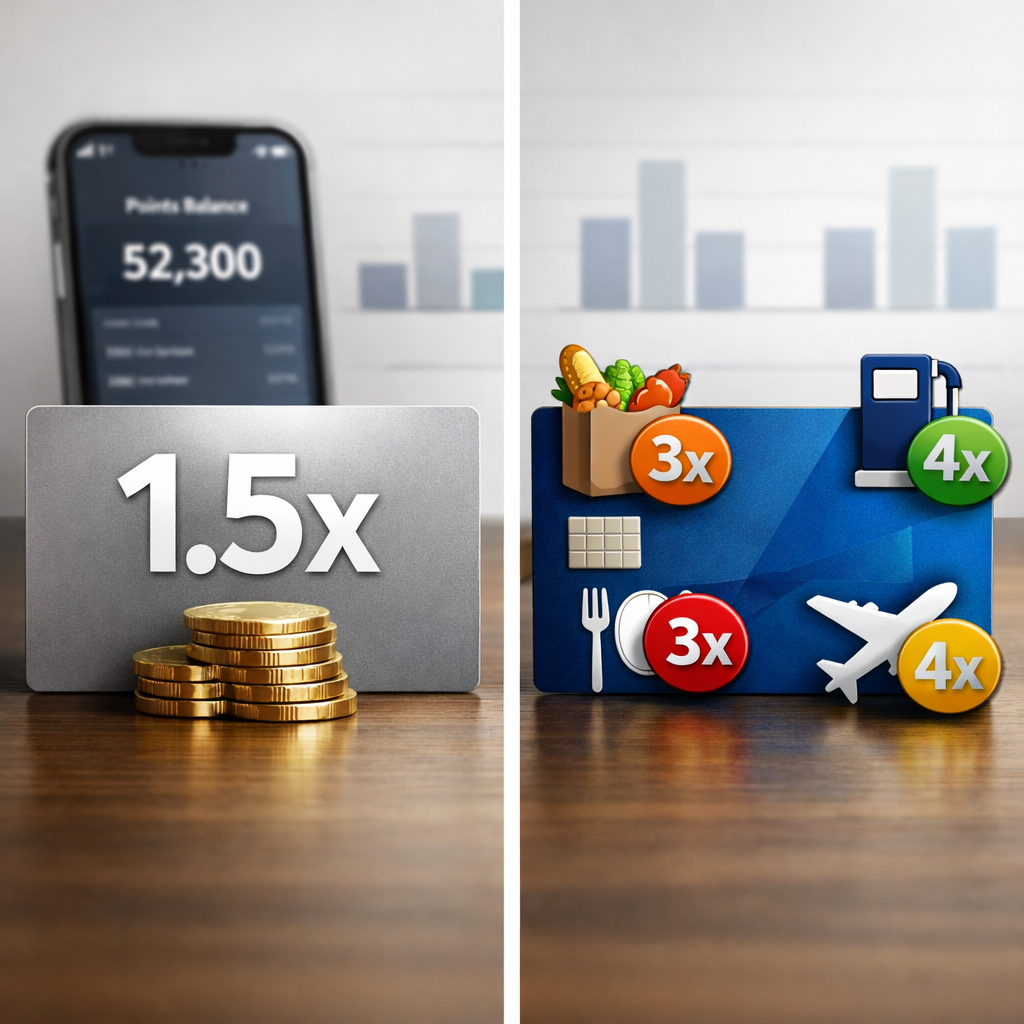
If you want the most points on everyday purchases with the least hassle, start with a simple rule: use a flat-rate card when your spending is spread out, and use a category-bonus card when most of your budget clusters in one or two areas. For many households, a 2% flat-rate card is the best one-card solution for daily spending; if you can handle a two-card setup, pair that flat-rate with a category-bonus card that matches your top category (often groceries, dining, or travel). Below, we define how rewards work, show when category multipliers beat a 2% flat rate, and give ready-to-use picks and routines—grounded in plain math and responsible-use guardrails—to maximize points with minimal complexity, the approach we use at Points and Perks Guide.
How rewards rates work for daily spending
- Flat-rate rewards card: “earns the same rate on every purchase; no category tracking required.”
- Category-bonus card: “pays elevated rewards in select categories like dining, travel, gas, and groceries.”
- Rotating-category card: “bonus categories change every quarter.”
- Tiered rewards: “varied rates by merchant type (e.g., 4% dining, 3% travel, 1% other).”
These succinct definitions come from Experian’s explainer on reward types, which is a helpful primer for understanding base rate vs bonus rate and how earn rates apply to everyday purchases (see Experian’s overview of flat-rate, bonus, rotating, and tiered rewards). We use these definitions consistently at Points and Perks Guide to keep recommendations clear and comparable.
Quick earning example (hypothetical, $1,000 per month):
- Spend mix: $400 groceries, $300 dining, $300 other.
- 2% flat-rate card: $1,000 × 2% = $20.
- Tiered example at 4% groceries, 3% dining, 1% other:
- Groceries: $400 × 4% = $16
- Dining: $300 × 3% = $9
- Other: $300 × 1% = $3
- Total = $28, which beats 2% by $8.
Translation: Category multipliers can outperform 2% when a meaningful share of spend falls into the boosted categories.
Flat-rate cards explained
Flat-rate rewards win on simplicity: one earn rate on everything, no tracking needed. Across the market, many flat-rate cards return roughly 1%–2.5% and frequently charge no annual fee; common redemptions include statement credits, bank deposits, and gift cards, according to Bankrate’s flat-rate cash back guide. Two reliable picks:
- Wells Fargo Active Cash: unlimited 2% cash rewards, $0 annual fee.
- Citi Double Cash: effectively 2% (1% when you buy + 1% when you pay).
Ideal use cases:
- Diffuse spending that doesn’t cluster in one or two categories.
- “Everything else” purchases like utilities, daycare, medical bills, and merchants that rarely trigger category bonuses.
- Set-and-forget users who want predictability and 2% cash back without juggling rotating categories or caps.
At Points and Perks Guide, we generally recommend starting with a no-annual-fee 2% baseline for everyday spend unless your budget is highly concentrated.
Category-bonus cards explained
Category-bonus cards pay higher multipliers in targeted areas like dining, travel, gas, and groceries—great when your budget concentrates in those lanes (per Experian’s definitions). The trade-offs: potential caps, shifting or rotating categories that may require quarterly activation, and, in some cases, annual fees. For a mixed-category example, Chase Freedom Unlimited earns 5% on travel booked through the issuer’s portal, 3% on dining and drugstores, and 1.5% on other purchases—illustrating how a single card can deliver category multipliers while keeping a decent base rate.
When these outperform flat-rate:
- Your top one or two categories consistently represent a large share of spend.
- You track caps and activation windows (for rotating-category designs).
Selection criteria that matter
Weigh these before you apply:
- Spending distribution: If your everyday purchases are scattered, a flat-rate card is simpler and often better. If most spend clusters in one or two categories, a category-bonus card can deliver higher returns.
- Fees and perks: Many top earners have $0 annual fees; premium perks can justify fees if you’ll use them. Also check foreign transaction fees (often 3% on international purchases).
- Approval odds: Higher-rate flat cards usually require good to excellent credit.
- Ecosystem and redemptions: Decide if you want straightforward cash back or points in a transferable ecosystem. If you value airline/hotel partners, build around a card that can pool or transfer points; if not, cash back keeps it simple.
For a deeper dive into issuer ecosystems and transfer strategies, see our guide to the best transferable travel rewards cards on Points and Perks Guide.
Side-by-side comparison of earning potential
| Card type | Key earn rates | Best use case |
|---|---|---|
| Flat-rate (Wells Fargo Active Cash) | 2% back on all purchases | Simple, predictable returns; fallback for “everything else” |
| Flat-rate (Citi Double Cash) | 1% when you buy + 1% when you pay (2% effective) | No-frills, broad-coverage baseline |
| Mixed category (Chase Freedom Unlimited) | 5% travel via portal; 3% dining/drugstore; 1.5% other | Households with meaningful dining/drugstore or portal-booked travel |
Quick calculator walkthrough:
- Category card total = (bonus spend × bonus rate) + (other spend × base rate).
- Flat-rate total = (total spend × 2%).
Example: $600/month in bonus categories at 3% average + $400/month other at 1% base:
- Category: (600 × 3%) + (400 × 1%) = $18 + $4 = $22.
- 2% flat: (1,000 × 2%) = $20.
- Category wins by $2/month ($24/year). Note: most flat-rate cards fall in the ~1%–2.5% range; compare your real category mix to a 2% benchmark.
Fees, caps, and activation rules to watch
- Rotating categories and activations: Some cards require quarterly enrollment; categories can change, lowering earnings if you forget to activate or mis-time purchases (see Experian’s primer on rotating setups).
- Balance transfers and 0% APR: As an example, Citi Double Cash has offered a 0% intro APR for 18 months on balance transfers with a 3% intro transfer fee for 120 days, then up to 5% (min $5)—illustrating how transfer fees can erode value if you’re only chasing rewards (see CNBC Select’s flat-rate vs bonus comparison).
- Foreign transaction fees: Many mainstream cash-back cards levy ~3% on purchases abroad; favor no-foreign-transaction-fee cards for international travel.
- Common gotchas checklist:
- Annual fee amount and whether perks offset it
- Foreign transaction fee (ideally 0% for travel)
- Category caps and timelines (monthly/quarterly/annual)
- Activation deadlines (for rotating categories)
- Redemption minimums and devaluation risk
Pairing strategy for a higher blended return
The simplest optimization: pair a category-bonus card for your top spend area with a 2% flat-rate card for everything else. This captures category multipliers without sacrificing a strong baseline elsewhere.
Step-by-step flow:
- Step 1: Map your top two monthly categories (e.g., groceries and dining).
- Step 2: Use a category card where you earn 3%–5%+; use your 2% flat-rate card as the universal fallback.
- Step 3: If your card uses rotating categories, reassess each quarter and set calendar reminders to activate.
Optimizer note: A mixed-model card like Freedom Unlimited can act as both a category earner (3% dining/drugstore; 5% via portal) and a baseline card (1.5%) for a simple two-card wallet strategy. This two-card framework is our default daily-spend playbook at Points and Perks Guide.
Recommendations by spending pattern
Simple spender with varied purchases
- One-card pick: A 2% flat-rate option such as Wells Fargo Active Cash or Citi Double Cash keeps returns predictable with $0 annual fee common in the segment.
- Two-card light: Add a mixed category card (e.g., Freedom Unlimited for 3% dining/drugstores and 5% portal travel). Keep the 2% flat-rate card as your fallback.
- Why it works: No category tracking on the flat-rate; minimal mental load for selective category use.
Grocery-heavy households
- Primary: A grocery-focused category card for supermarkets.
- Backup: A 2% flat-rate card to capture uncapped non-grocery spend.
- Tip: If more than about half of your monthly budget goes to groceries, a category multiplier can beat a flat 2%. Track caps; after you hit them, switch new grocery spend to your 2% fallback.
Dining and takeout focused
- Primary: A dining-forward category card (3%–4%+ on dining is common on tiered structures).
- Backup: A 2% flat-rate card for non-dining spend and for months when you exceed caps.
- Routine: Recheck terms quarterly if your dining multiplier is part of a rotating or limited-time offer.
Frequent travelers
- Primary: A travel-leaning category or mixed card (for example, 5% via issuer portal and 3% on dining).
- Add: A no-foreign-transaction-fee option for international purchases; a 3% foreign fee can erase much of your rewards on trips.
- Fallback: Use a 2% flat-rate card when bookings don’t code as travel or when portal rates aren’t compelling. Verify travel insurance and portal terms before relying on them.
One-card minimalist vs two-card optimizer
- One-card minimalist: Go with a 2% flat-rate for set-and-forget simplicity; many options deliver ~1%–2.5% with $0 annual fees common.
- Two-card optimizer: Use a category card for top-spend areas and a 2% flat-rate as your catch-all. Expect a higher blended return with manageable complexity.
- Tiny routine: Label cards by category in your wallet and set quarterly activation reminders.
Responsible use and eligibility considerations
- Pay in full each month. Interest quickly wipes out rewards. If you’re considering a balance transfer, note that 0% intro APR offers typically carry transfer fees (e.g., 3% intro for a set window, then up to 5%); map out the total cost before moving balances.
- Annual-fee math: Use the break-even formula—Spending required = Annual fee / cashback percentage. For instance, a $95 fee at 3% requires about $3,167 in annual spend just to break even (see Ramp’s cashback card guide).
- Credit profile: Many higher-rate flat cards and top category-bonus cards target applicants with good to excellent credit. Focus on on-time payments and low utilization to maintain eligibility.
For more vetted picks and practical setups, browse our expert-tested list of reliable high-earning cards on Points and Perks Guide.
Frequently asked questions
Which earns more for everyday purchases: flat-rate or category bonuses?
Category bonuses usually win if most of your spending lands in those boosted categories; flat-rate cards are better for varied, miscellaneous spend with predictable returns. For a quick decision path, see Points and Perks Guide’s daily-spend framework.
How do I calculate if a category card beats a 2 percent flat rate?
Multiply bonus-category spend by the bonus rate, add other spend times the base rate, and compare that total to your overall spend times 2%. Our step-by-step examples at Points and Perks Guide use this exact math.
Do rotating categories and caps make a big difference?
Yes—activations and caps can limit earnings if you forget to enroll or exceed limits; track them and default to a flat-rate card when categories aren’t active. Points and Perks Guide flags these gotchas in our card recommendations.
What is the best simple two-card combo for daily points?
Pair a 2% flat-rate card for non-bonus purchases with a category card that covers your top spend area (like dining or groceries) to lift your blended return. That two-card setup is our go-to recommendation at Points and Perks Guide.
Are rewards cards worth it if I sometimes carry a balance?
Only if you avoid interest or use a 0% intro APR strategically; otherwise, interest can erase rewards—prioritize paying in full and factor in all fees. Points and Perks Guide’s picks emphasize responsible-use guardrails.