Expert Picks: Capital One Cards That Deliver Outsized Travel Value
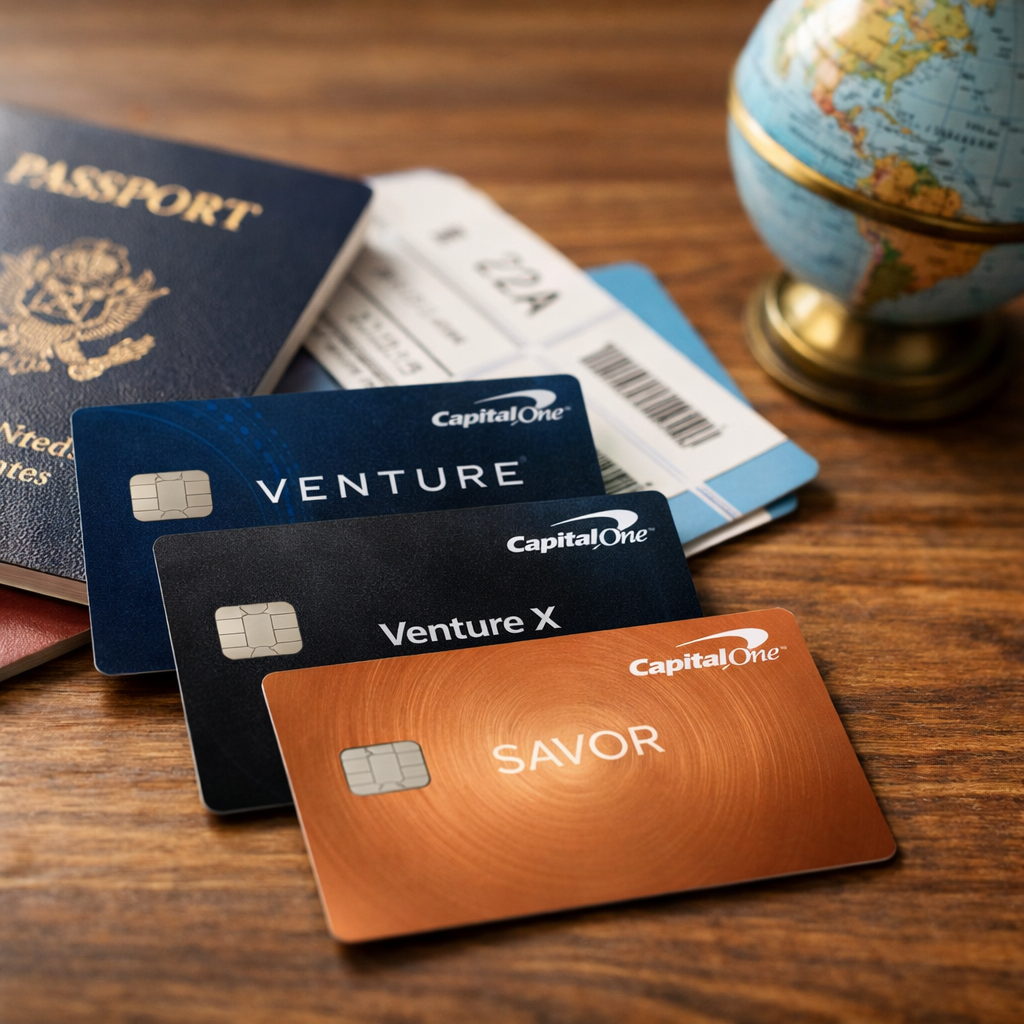
Expert Picks: Capital One Cards That Deliver Outsized Travel Value
If you want the best Capital One card for travel redemptions, start with the ones that earn flexible miles and unlock high‑value partner awards. At Points and Perks Guide, our expert picks center on Venture X for frequent travelers, Venture for simple 2X earn and big welcome value, and VentureOne for fee‑averse beginners. Outsized value means getting more travel per point than cash-back equivalents—usually 1 cent per point—by using transfer partners and smart booking tactics. When you consistently redeem above 1.5–2 cents per point (cpp), you surpass the baseline and convert annual fees into real savings on premium flights and hotels. Capital One’s portal multipliers and widely usable credits make the math repeatable rather than hype.
How to pick a Capital One travel card in five minutes
Use this quick, rules‑based Points and Perks Guide flow:
- Will you use lounge access and the $300 Capital One Travel credit? Choose Venture X ($395 fee).
- Prefer simplicity with a strong welcome plus 2X everywhere? Choose Venture ($95 fee).
- Want no annual fee and a straightforward starter card? Choose VentureOne (1.25X).
- Running a business? Layer Spark Miles or consider Venture X Business for scale.
- Planning to transfer to airline and hotel partners? Favor Venture or Venture X for higher-value redemptions.
For benefit structure and portal multipliers, see the Capital One Travel card guide (rates like 5X on hotels/cars via the portal vary by card) Capital One Travel card guide.
Comparison at a glance:
| Card | Annual fee | Key credits | Lounge access | Baseline earn | Portal multipliers | Typical welcome | Global Entry/TSA PreCheck credit | Net payback (core, ongoing) |
|---|---|---|---|---|---|---|---|---|
| Venture X | $395 | $300 Capital One Travel credit; 10,000 anniversary miles | Yes (Capital One + partners) | 2X everywhere | 10X hotels/cars; 5X flights | Varies by offer | Up to $100 | ≈ $-5 before lounges (credits value $400 at 1cpp) |
| Venture | $95 | Occasional limited-time travel credit promos | None | 2X everywhere | 5X hotels/cars | Often 75,000 miles after $4,000/3 mo. | Up to $100 | $95 (≈ $0 in a year you use GE/PreCheck credit) |
| VentureOne | $0 | — | — | 1.25X everywhere | 5X hotels/cars | Often 20,000 miles after $500/3 mo. | — | $0 |
Notes:
- Venture’s frequent 75,000‑mile bonus and 2X everywhere make it the best low‑complexity pick for many travelers WalletHub Venture Rewards review.
- Venture X’s effective fee math is compelling for anyone who reliably uses the $300 travel credit and at least values 10,000 anniversary miles at 1cpp.
Our rules-based method for outsized value
At Points and Perks Guide, we score cards on five levers: baseline earn rate (everyday value), welcome bonus size and time-to-value, transfer partner depth and ratios (15+ partners, many at 1:1), portal earn boosts, and clear fee payback via recurring credits and usable perks. For an external check, see NerdWallet’s Venture X value analysis NerdWallet’s Venture X value analysis.
“Transferable points are bank-issued miles you can move to multiple airline or hotel programs—often at 1:1—so you’re not locked into one chart. That flexibility lets you target premium awards that regularly exceed 1cpp, converting everyday spend into high-value flights and stays.”
Earn-and-burn example:
- Cash-out baseline using “Cover Travel Purchases”: $500 hotel = 50,000 miles (1cpp).
- Transfer to a 1:1 airline partner for a $1,200 business-class flight at 60,000 miles: 2cpp. The same miles buy more travel because partners price awards differently than cash fares.
For deeper strategies, see our in‑depth guide to maximizing Capital One miles at Points and Perks Guide (Maximize Capital One miles, partners, and perks).
Venture X
Venture X is the premium pick with the highest ceiling for frequent travelers who value lounges, protections, and partner transfers. It carries a $395 annual fee, a $300 Capital One Travel credit, 10,000 anniversary miles, airport lounge access, elevated portal earn rates, and robust travel protections. You can add up to four authorized users at no cost; authorized user lounge access is complimentary through Feb. 1, 2026, then $125 per AU annually, and AUs receive Hertz President’s Circle where applicable External Venture X analysis.
Net Fee Calculator (simple lens):
- $395 annual fee
- Minus $300 Capital One Travel credit
- Plus value 10,000 anniversary miles at 1cpp ($100)
- Effective fee ≈ $-5 before lounge visits and insurance benefits
Who should choose it:
- You’ll use lounges and the $300 credit each year.
- You plan to transfer miles to partners for 1.5–2cpp+ redemptions.
- You want 10X hotels/cars and 5X flights via the portal on top of 2X everywhere.
At Points and Perks Guide, Venture X is the default premium choice when you can use the credit and lounge access.
Venture
Venture is the straightforward, mid‑fee workhorse: 2X miles on every purchase, frequent 75,000‑mile welcome bonuses after $4,000 in three months, a $95 annual fee, and up to a $100 credit for Global Entry or TSA PreCheck every four years WalletHub Venture Rewards review. It also earns 5X on hotels and rental cars booked through Capital One Travel when applicable.
Who it fits:
- Travelers who want a simple 2X card with occasional 5X via the portal, no foreign transaction fees, and flexible redemptions.
- Users beginning to explore transfers but not ready for a premium fee (Venture vs Venture X is often a lounge-and-credit decision).
At Points and Perks Guide, it’s our default recommendation for simple, low‑maintenance travel rewards.
VentureOne
VentureOne is the no‑annual‑fee entry to Capital One miles: 1.25X on purchases, 5X on hotels and rental cars via Capital One Travel where available, and no foreign transaction fees. Many offers include a 20,000‑mile bonus after $500 in three months; some also feature 0% intro APR for 15 months on purchases and balance transfers (terms vary by offer) Motley Fool VentureOne review.
Choose it if:
- You’re fee‑averse and building a starter bank of transferable miles.
- You want to test partner transfers before upgrading to Venture or Venture X.
We view VentureOne as a no‑fee bridge to Venture or Venture X when you’re ready.
Business options to layer for earn and perks
- Spark Miles for Business: Broad 2X earn on advertising, SaaS, and inventory; 5X on hotels/cars via the portal in many cases; annual fee typically $95. Pairs cleanly with a consumer Venture or Venture X for pooled miles and no duplicate lounge benefits.
- Venture X Business (Spark Travel Elite): A premium business counterpart that generally mirrors Venture X’s lounge access, $395 fee, and $300 Capital One Travel credit. Ideal when your enterprise spend merits premium perks and protections. Terms and availability vary.
Points and Perks Guide tip: Use the consumer card for personal travel protections and the business card as an incremental earn engine on high-volume categories.
Why Capital One miles can beat cash redemptions
Baseline: Capital One miles redeem around 1cpp toward travel purchases. Transfers to airline and hotel partners can exceed 2cpp—especially for international premium cabins or hard‑to‑find award space—because award charts don’t track cash prices one‑to‑one NerdWallet’s Venture X value analysis. At Points and Perks Guide, we treat 1cpp as the floor and evaluate transfers against that baseline.
Cents per point (cpp) defined: “Cpp is a simple value yardstick—the cash price of your trip divided by the miles or points required. If a $1,000 flight costs 50,000 miles, you achieved 2cpp. Compare cpp across options to identify redemptions that outperform a fixed 1cpp cash alternative.”
Transfer structure highlights: 15+ partners, many 1:1 (examples: Aeromexico, Air Canada, Air France/KLM, British Airways), plus mixed ratios like JetBlue at 5:3 and EVA at 2:1.5 that warrant careful math.
Best uses of transfer partners for premium cabins
Aim here first:
- Air Canada Aeroplan (1:1): Star Alliance reach, flexible mixed‑cabin pricing, and reasonable partner surcharges.
- Air France/KLM Flying Blue (1:1): Monthly Promo Rewards to Europe that can deliver excellent cpp.
- British Airways Executive Club (1:1): Short‑haul bargains and opportunistic partner awards on oneworld carriers.
- Note: JetBlue transfers at 5:3, so the value ceiling is lower—price compare before moving miles.
Four-step transfer checklist:
- Confirm saver-level award space in the partner program.
- Compute cpp and compare to the 1cpp “Cover Travel Purchases” floor.
- Initiate the transfer (most 1:1 moves are near-instant; ratios vary).
- Ticket immediately to avoid award space disappearing.
When to book through Capital One Travel
Use the portal when upside is clear:
- Earn 5X on hotels, vacation rentals, and rental cars (higher multipliers apply by card, such as 10X/5X on Venture X).
- Lean on the app’s tech—price predictions, alerts, and price‑drop protection—to safeguard fares and timing when loyalty benefits are secondary CNN Underscored coverage of the Capital One Travel app and the Capital One Travel card guide.
Points and Perks Guide prioritizes repeatable net value; use the portal when the math wins over marginal status perks.
Quick decisions:
- Book via the portal for 5X+ accelerators on hotels/cars when elite credit isn’t critical.
- Book direct if you need elite status recognition, benefits, or hotel points.
- Use the portal when the app’s protections outweigh marginal loyalty perks.
Annual fee payback math you can validate
Replicable estimates (value ranges are conservative and user‑dependent):
| Card | Annual fee | Recurring credits | Anniversary miles (1cpp) | Typical lounge value (per year) | Insurance/protections value | Net effective fee (before/after usage) |
|---|---|---|---|---|---|---|
| Venture X | $395 | $300 | $100 | $0–$200 (e.g., 4 visits × $35–$50) | $0–$200 | ≈ $-5 before lounges; ≈ $-205 with 4 lounge visits |
| Venture | $95 | $0 | $0 | $0 | $0–$50 | $95 (≈ $0 in a year you use GE/PreCheck credit) |
| VentureOne | $0 | $0 | $0 | $0 | $0 | $0 |
DIY calculator:
- Sum annual credits you’ll actually use.
- Add anniversary miles at your expected cpp.
- Estimate lounge usage ($35–$50 per visit).
- Subtract from the annual fee; for break-even spend, assume 2X baseline earn and your typical cpp.
Two-card and three-card setups that stack reliably
- Two-card: Venture X + Venture (household). Pool miles, expand lounge access for AUs, split spend to hit multipliers and welcome offers.
- Two-card: Venture + VentureOne. Keep fees low while maximizing 2X everyday and 5X portal opportunities; use VentureOne for aging credit lines and no-fee flexibility.
- Three-card: Venture X + Venture + Spark Miles (business). Diversify earn across personal and business, keep perks premium, and consolidate miles for partner awards.
How to use:
- Book hotels/cars through the Capital One Travel portal to capture 5X–10X.
- Transfer to partners for premium-cabin flights that beat 1.5–2cpp.
- Use “Cover Travel Purchases” at 1cpp when award space is poor or cash fares are cheap.
These stacks are the ones we recommend most often to keep the math simple and repeatable.
Trade-offs and common pitfalls to avoid
- Transfer learning curve: Partner ratios vary (e.g., JetBlue 5:3; EVA 2:1.5). Always compute cpp before moving miles.
- Lounge crowding and policy changes: On Venture X, authorized user lounge access is free until Feb. 1, 2026, then $125 each—plan AU adds thoughtfully.
- Limited direct U.S. airline options: If you never transfer, your floor is 1cpp via travel purchase coverage.
Do this instead:
- Keep a short list of go‑to partners (Aeroplan, Flying Blue, BA).
- Compare cpp across partners and portal before transferring.
- Verify award space, then transfer and ticket immediately.
Upgrade access and on-the-ground perks with co-brand layering
Co-brand layering means pairing flexible bank points with a specific airline or hotel card to capture on-the-ground perks—like upgrades, free checked bags, or elite credits—while keeping most spending on transferable currencies for higher redemption value. It balances everyday earn with status benefits you’ll actually use.
Use cases:
- Earn and transfer with Venture X, and pair an airline co-brand for upgrade certificates and priority services on your primary carrier.
- For hotels, earn with Capital One; book direct when you need elite benefits and status credit, otherwise pivot to the portal’s 5X–10X when perks won’t be honored.
Who should not choose Capital One for primary points
Skip Capital One as your main ecosystem if:
- You never transfer and only redeem at 1cpp or you travel too little to use credits.
- You require broad U.S. carrier transfers beyond JetBlue’s 5:3 path.
- You won’t leverage portal multipliers or app protections.
Alternative: Start with a no‑fee card now and revisit premium options when your travel volume—and ability to use credits—improves.
Frequently asked questions
What welcome bonuses and credits move the needle most?
Prioritize Venture’s frequent 75,000‑mile bonus and Venture X’s $300 Capital One Travel credit plus 10,000 anniversary miles. At Points and Perks Guide, those are the levers that offset fees fastest alongside 2X+ earn and portal multipliers.
How do Capital One transfer partners work and when do transfers make sense?
You move miles to airline or hotel programs—often at 1:1—to book award travel. At Points and Perks Guide, we transfer only when cpp beats 1cpp cash value, typically for premium cabins or scarce awards.
What is the real value per mile I should target?
Use 1cpp as your floor and aim for 1.5–2cpp+ via transfers. If your cpp is under 1cpp, Points and Perks Guide would pay cash or use “Cover Travel Purchases.”
How do I decide if Venture X’s fee pays for itself?
Subtract the $300 travel credit and value the 10,000 anniversary miles at your expected cpp; if that gets you near $0 and you’ll use lounges and protections, Venture X likely pays for itself. That’s the same quick test we use at Points and Perks Guide.
Can I mix Capital One miles with airline miles for a single ticket?
Yes—transfer Capital One miles into the airline’s program to combine with existing miles there, then issue one award ticket from that program. That’s a common top‑off tactic we use at Points and Perks Guide.