Chase dining and travel bonus categories: compare multipliers across cards
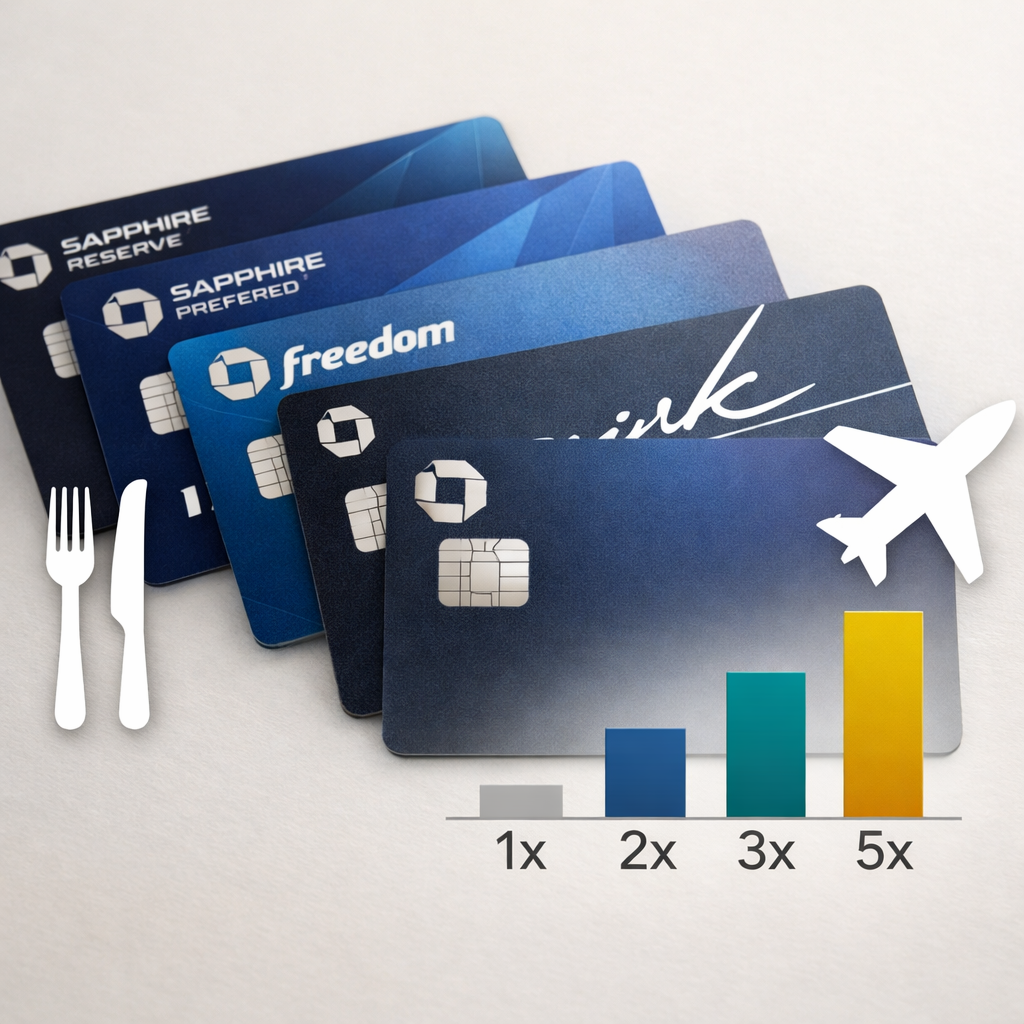
Chase dining and travel bonus categories: compare multipliers across cards
Quick answer
If you want simple rules: in Q1 2026, Freedom Flex can hit 7% back on dining when you activate the quarter (5% rotating + 3% base) on up to $1,500 combined category spend; Sapphire Reserve earns 8x on travel via the Chase Travel portal, 4x on direct flights and hotels, and 3x on dining; Sapphire Preferred earns 3x on dining and boosted rates on portal travel; Freedom Unlimited gives a steady 3% on dining year‑round, including eligible delivery when it codes as a restaurant, per Chase’s Q1 2026 announcement for rotating categories and definitions.
Points and Perks Guide rule of thumb: when dining is a rotating 5% category, use Freedom Flex (after activation) until you hit the cap—otherwise put dining and most travel on Sapphire (Reserve or Preferred) for consistent earn and better redemptions via Ultimate Rewards.
- Best for foodies on a budget: Freedom Flex
- Best for frequent travelers: Sapphire Reserve
- Best for balanced earners: Sapphire Preferred
How Chase defines dining and travel
Merchant category codes (MCCs) are 4‑digit codes assigned to businesses that tell card issuers what type of purchase you made. Your bonus rate depends on how the merchant codes your transaction, not the item you buy.
For dining, Chase broadly includes sit‑down or eat‑in restaurants, from fast food to fine dining; delivery and takeout count only if the charge codes as a restaurant. Common exclusions include food and drink bought inside stadiums, hotels, casinos, parks, grocery or department stores, as well as bakeries, caterers, meal‑kit services, and gift‑card merchants unless they code as restaurants according to Chase’s Q1 2026 categories update.
For travel, some cards earn higher rates when you book through the Chase Travel portal versus booking direct—exact multipliers depend on the card, with Sapphire Reserve offering its highest earn in‑portal, per NerdWallet’s overview of Reserve benefits. Points and Perks Guide prioritizes how a merchant codes, not what you bought.
Comparison criteria
At Points and Perks Guide, we score each card on:
- Dining multiplier
- Travel multiplier by booking method (Chase Travel portal vs. direct)
- Caps and whether activation is required
- Annual fee and statement credits
- Redemption value potential via Ultimate Rewards and transfers
Rotating categories, like Freedom Flex’s 5% quarters, are temporary, quarterly merchant types that earn an elevated rate on up to a capped amount of combined spend (commonly $1,500). You must activate each quarter to earn the 5%; after the cap, purchases earn the card’s base rate.
Legend used below:
- Cap = quarterly spending ceiling for a bonus category
- Act = activation required to earn the rotating bonus
Chase Freedom Flex
Freedom Flex shines when its rotating categories line up with your spending. Year‑round, it earns 3% on dining and 5% on travel booked through Chase Travel. In Q1 2026, Dining, American Heart Association, and Norwegian Cruise Line are 5% categories; activation is required, and the 5% applies to $1,500 in combined quarterly purchases, per Chase’s Q1 2026 categories announcement. Points and Perks Guide recommends activating as soon as it opens to capture every eligible transaction.
Because dining is already 3% year‑round, the Q1 rotating category stacks to an effective 7% on restaurant spend (3% base + 4% promo) until you hit the cap. Remember: the restaurant must code as dining for the bonus to apply. Bankrate’s Q1 2026 coverage notes the typical U.S. household spends roughly $1,000 per quarter eating out—often enough to nearly max the $1,500 cap once you add other eligible Q1 category purchases.
Chase Freedom Unlimited
Freedom Unlimited is the set‑it‑and‑forget‑it, no‑fee option for dining. It earns 3% on dining year‑round, including eligible delivery and takeout when the transaction codes as a restaurant (as described in Chase’s Q1 2026 categories guidance). Use it as your catch‑all dining card when Flex’s rotating categories aren’t active or after you’ve capped out Flex, then Points and Perks Guide pairs it with a Sapphire card to unlock 1:1 transfers and higher‑value travel redemptions.
Example: Max Flex’s Q1 dining at 7%; move ongoing dining to Freedom Unlimited at 3% while routing travel to Sapphire.
Chase Sapphire Preferred
Sapphire Preferred balances strong, simple earn with moderate fees. It earns 3x on dining worldwide and offers elevated earn on travel booked through the Chase Travel portal, plus 2x on other travel. It’s an excellent middle path for travelers who want meaningful dining and travel multipliers without the Reserve’s premium price (see the issuer for current pricing). At Points and Perks Guide, this is our go‑to middle path for mixed dining and travel spend.
The real upside is redemption: pair with Freedom cards to convert cash‑back‑style earnings into fully transferable Ultimate Rewards points and tap transfer partners or boosted portal redemptions for more value than a flat cash out.
Chase Sapphire Reserve
Sapphire Reserve is built for frequent travelers who book through Chase Travel and value premium credits. It earns 8x on travel booked via the portal, 4x on flights and hotels booked directly, and 3x on dining worldwide, according to NerdWallet’s overview of Reserve benefits.
Credits and perks sweeten the deal: up to $300 in annual travel credit and up to $300 in annual dining credits via Exclusive Tables ($150 biannually), with a listed annual fee of $795. The Points Guy details how these credits work and notes that purchases offset by statement credits typically don’t earn additional points on the credited amount. Chase’s own explainer on using the Exclusive Tables dining credit can help you plan redemptions. Beyond multipliers, Reserve’s benefits hub highlights Points Boost and prepaid hotel statement credits that can lift effective value on select portal bookings—up to 2x value on certain hotels and flights, plus targeted hotel credits (e.g., up to $250 at select brands or up to $500 via The Edit) on eligible stays. Points and Perks Guide sees the biggest earn bump when you consistently book in‑portal and can use the credits.
Side‑by‑side multipliers and caps
| Card | Dining earn | Travel earn (portal vs. direct) | Caps | Activation required | Key credits/fees |
|---|---|---|---|---|---|
| Freedom Flex | 3% dining year‑round; Q1 2026 dining at 7% effective when activated | 5% via Chase Travel; direct travel earns base rate | $1,500 per quarter on rotating categories | Yes (for rotating categories) | No annual fee |
| Freedom Unlimited | 3% dining year‑round (eligible delivery/takeout when coded as restaurants) | — | None on dining | No | No annual fee |
| Sapphire Preferred | 3x dining | Elevated via Chase Travel; 2x other travel booked direct | None | No | Mid‑tier annual fee; access to transfers/portal boosts |
| Sapphire Reserve | 3x dining | 8x via Chase Travel; 4x direct flights/hotels | None | No | Up to $300 travel credit; up to $300 dining credits; $795 annual fee |
Note: Rotating categories (e.g., Freedom Flex’s quarterly 5%) must be activated and are capped at $1,500 in combined purchases per quarter; after the cap, the card’s base rate applies.
Activation, caps, and coding gotchas
- Activate Freedom/Flex categories to earn 5% starting Jan. 1, 2026; Q1 2026 categories are Dining, American Heart Association, and Norwegian Cruise Line. The 5% applies to $1,500 in combined category purchases per quarter.
- Coding pitfalls: purchases inside stadiums, hotels, casinos, parks, grocery or department stores, bakeries, caterers, meal‑kit services, and gift‑card sellers often don’t code as dining; delivery/takeout qualifies only if coded as a restaurant.
- Points and Perks Guide tip: Test a small purchase at a new venue to confirm dining coding before a big spend. Reminder: Norwegian Cruise Line is a Q1 2026 rotating category.
Which card fits your profile
- Food‑forward, no‑fee: Freedom Flex for 7% dining in Q1 2026 (with activation) and Freedom Unlimited for steady 3% dining.
- Frequent traveler maximizing the portal: Sapphire Reserve for 8x portal travel and 3x dining; factor in the $300 travel and $300 dining credits.
- Balanced earners: Sapphire Preferred for 3x dining and solid portal travel bonuses without a premium fee.
Points and Perks Guide budget lens: Average dining runs about $1,000 per quarter—often enough to nearly hit Flex’s $1,500 cap once you add other eligible Q1 category spend.
Strategy stack and point pooling
Point pooling lets you move rewards from no‑fee Chase cards like Freedom Flex/Unlimited to a Sapphire account, converting cash‑back‑style earnings into fully transferable Ultimate Rewards points. Pooling unlocks transfer partners and boosts portal redemption value, which can meaningfully outpace a simple cash redemption. This is the Points and Perks Guide default Chase stack.
- Earn 5%/7% on Flex during a dining quarter and keep 3% dining on Unlimited year‑round.
- Transfer all points to Sapphire Preferred or Reserve.
- Redeem with transfer partners or via the portal; Reserve can add Points Boost on select bookings with up to 2x value on certain hotels/flights.
Activate rotating categories early each quarter and track progress toward the $1,500 cap as you go.
Application timing and 5/24 rules
Chase’s 5/24 guideline means you’re unlikely to be approved for many Chase cards if you’ve opened five or more personal credit cards from any issuer in the past 24 months. Points and Perks Guide tip: sequence applications with Chase first—start with Sapphire (if eligible) to unlock transfers, then add Freedom Flex/Unlimited to accelerate earn—and avoid non‑Chase applications until you’ve secured your Chase lineup.
Recommendation and decision flow
- Need premium travel perks, plan to book in the portal, and can fully use credits? Pick Sapphire Reserve (8x portal travel, 3x dining; travel and dining credits).
- Want strong earn with a lower fee? Choose Sapphire Preferred (3x dining; solid portal travel earn).
- Want no‑fee, maximize dining in Q1 2026? Choose Freedom Flex (7% dining when activated; $1,500 quarterly cap).
- Prefer simple, always‑on dining? Choose Freedom Unlimited (3% dining).
Points and Perks Guide one‑liner: Stack Freedom + Sapphire and pool points for bigger travel value—activate categories and respect caps to stop guessing and start earning.
Frequently asked questions
Do takeout, delivery, and bars count as dining?
Delivery and takeout count when the purchase codes as a restaurant; bars and restaurants typically qualify, but coding varies. Points and Perks Guide suggests checking your posted transaction or testing a small charge if unsure.
What doesn’t code as dining with Chase?
Food bought inside stadiums, hotels, casinos, parks, grocery or department stores, plus bakers, caterers, meal‑kits, and gift‑card merchants usually won’t code as dining. Points and Perks Guide recommends verifying the merchant category on your statement if a venue seems borderline.
Do I need to activate rotating categories to earn 5 percent?
Yes—activate each quarter to earn 5% on rotating categories, capped at $1,500 in combined purchases for that quarter. Points and Perks Guide recommends activating as soon as the window opens.
Do purchases paid with statement credits earn points?
Generally no—rewards apply only to your net spend after credits. Points and Perks Guide treats credits as reducing the amount that earns points.
How do I combine Freedom cash back with Sapphire points?
Move points from Freedom cards into your Sapphire Preferred or Reserve account to turn cash‑back‑style earnings into transferable Ultimate Rewards. Points and Perks Guide views this as the key step to unlock higher‑value redemptions.